Astrology is a group of systems, traditions, and beliefs which hold that the relative positions of celestial bodies and related details can provide information about personality, human affairs and other "earthly" matters. A practitioner of astrology is called an astrologer. Few astrologers believe that the movements and positions of celestial bodies either directly influence life on Earth or correspond to events experienced on a human scale.[] More common is the idea that astrology is a symbolic language, an art form, or a form of divination. Despite differences in definitions, a common assumption of astrologers is that celestial placements can aid in the interpretation of past and present events, and in the prediction of the future.
Astrology is considered a pseudoscience or superstition by the scientific community, which sees a lack of statistically significant astrological predictions, while psychology explains much of the continued faith in astrology as a matter of cognitive biases. 2006 the U.S. National Science Board published a statement which said it considers belief in ten survey items, astrology among them, to be "pseudoscientific".
Numerous traditions and applications employing astrological concepts have arisen since its earliest recorded beginnings in the 3rd millennium BC. Astrology has played an important role in the shaping of culture, early astronomy, the Vedas, and various disciplines throughout history. In fact, astrology and astronomy were often regarded as synonyms before the modern era, with the desire for predictive and divinatory knowledge one of the motivating factors for astronomical observation. Astronomy began to diverge from astrology after a period of gradual separation from the Renaissance up until the 18th century. Eventually, astronomy distinguished itself as the empirical study of astronomical objects and phenomena, without regard to the terrestrial implications of astrology.
The word "astrology" comes from the Latin term astrologia ("astronomy"), which in turn derives from the Greek noun αστρολογία: ἄστρον, astron ("constellation" or "star") and -λογία, -logia ("the study of"). The word "starcraft" has also traditionally been used to mean astrology.
Core beliefs
The core beliefs of astrology were prevalent in parts of the ancient world and are epitomized in the Hermetic maxim, "as above, so below". Tycho Brahe used a similar phrase to summarize his studies in astrology: suspiciendo despicio, "by looking up I see downward". Although the principle that events in the heavens are mirrored by those on Earth was once generally held in most traditions of astrology around the world, in the West there has historically been a debate among astrologers over the nature of the mechanism behind astrology.
Although the connection between celestial mechanics and terrestrial dynamics was explored first by Isaac Newton with his development of a universal theory of gravitation, claims that the gravitational effects of the celestial bodies are what accounts for astrological generalizations are not substantiated by scientific research.
Most astrological traditions are based on the relative positions and movements of various real or construed celestial bodies and on the construction of implied or calculated celestial patterns as seen at the time and place of the event being studied. These are chiefly the astrological planets, the stars, the lunar nodes, Arabic parts and hypothetical planets. The frame of reference for such apparent positions is defined by the tropical or sidereal zodiac of twelve signs on one hand, and by the local horizon (ascendant-descendant axis) and midheaven-imum coeli axis on the other. This latter (local) frame is typically further divided into the twelve astrological houses. Furthermore, the astrological aspects are used to determine the geometric/angular relationship(s) between the various celestial bodies and angles in the horoscope.
Predictive astrology, in the Western tradition, employs two main methods: astrological transits and astrological progressions. In astrological transits the ongoing movements of the planets are interpreted for their significance as they transit through space and the horoscope. In astrological progressions the horoscope is progressed forward in time according to set methods. In Vedic astrology, the focus is on planetary periods to infer the trend, while transits are used to time significant events. Most Western astrologers no longer try to forecast actual events, but focus instead on general trends and developments. By comparison, Vedic astrologers predict both trends and events. Skeptics respond that this practice of western astrologers allows them to avoid making verifiable predictions, and gives them the ability to attach significance to arbitrary and unrelated events, in a way that suits their purpose.
In the past, astrologers often relied on close observation of celestial objects and the charting of their movements. Modern astrologers use data provided by astronomers which are transformed to a set of astrological tables called ephemerides, showing the changing zodiacal positions of the heavenly bodies through time.
Traditions
There are many traditions of astrology, some of which share similar features due to the transmission of astrological doctrines between cultures. Other traditions developed in isolation and hold different doctrines, though they too share some features due to drawing on similar astronomical sources.
Current traditions
The main traditions used by modern astrologers are Hindu Astrology (Jyotiṣa), Western astrology, and Chinese astrology.
Vedic and Western astrology share a common ancestry as horoscopic systems of astrology, in that both traditions focus on the casting of an astrological chart or horoscope, a representation of celestial entities, for an event based on the position of the Sun, Moon, and planets at the moment of the event. However, Vedic astrology uses the sidereal or fixed or constellational zodiac, linking the signs of the zodiac to their original constellations, while Western astrology uses the tropical or seasonal zodiac. Because of the precession of the equinoxes whose cycle is ~25,686 years long, during which the extensions of the polar axes describe circles, the twelve zodiacal signs in Western astrology no longer correspond to the same part of the sky as their original constellations, due to centuries of change. In effect, in Western astrology the link between sign and constellation was broken in approximately 222 AD, whereas in Vedic astrology the constellations remain of paramount importance. Other differences between the two traditions include the use of 27 (or 28) nakshatras or lunar mansions, each 13⅓ degrees wide, which have been used in India since Vedic times, and the systems of planetary periods known as dashas.
In Chinese astrology, a quite different tradition has evolved. By contrast to Western and Indian astrology, the twelve signs of the zodiac do not divide the sky, but rather the celestial equator. The Chinese evolved a system in which each sign corresponds to one of twelve "double-hours" that govern the day, and to one of the twelve months. Each sign of the zodiac governs a different year, and combines with a system based on the five elements of Chinese cosmology to give a 60 (12 × 5) year cycle. The term Chinese astrology is used here for convenience, but it must be noted that versions of the same tradition exist in Korea, Japan, Vietnam, Thailand and other Asian countries. It appears that this is a remnant of a more ancient system of Jupiterian astrology, an astrological system primarily based on the motion of Jupiter, which orbits the Sun every 11.89 years.
Western astrology has been the result of the knowledge of the earlier Indian/Vedic and Egyptian schools (each developed in their own right, and neither shows traces of the later Babylonian influences) being diluted and simplified in passing first through Persia/Babylon, and then through Greece, and later Europe. In modern times, these traditions have come into closer contact with each other, notably with Indian and Chinese astrology having spread in more direct form to the West, while awareness of the modern notions of Western astrology is still fairly limited in Asia, and is not considered useful. Astrology in the Western world has diversified among some in modern times. New movements have appeared that have jettisoned much of more recent traditional astrology to concentrate on different approaches, such as a greater emphasis on midpoints, or a more psychological approach. Some recent Western developments include modern tropical and sidereal horoscopic astrology, including constellational and star or point-based astrology (including aspects to the fundamental planetary dynamics, such as perihelions and aphelions, and nodal points resulting from the inclinations of the planets' revolutionary planes to the Earth's ecliptic plane); heliocentric astrology, cosmobiology; psychological astrology; sun sign astrology; the Hamburg School of Astrology; and Uranian astrology, a subset of the Hamburg School.
Esoteric traditions
Horoscopic astrology
Horoscopic astrology is a system that some claim to have developed in the
Mediterranean region and specifically
Hellenistic Egypt around the late 2nd or early 1st century BC. However, horoscopic astrology has been practiced in India since ancient times, and
Vedic astrology is the oldest surviving form of horoscopic astrology in the world. The tradition deals with two-dimensional diagrams of the heavens, or horoscopes, created for specific moments in time. The diagram is then used to interpret the inherent meaning underlying the alignment of celestial bodies at that moment based on a specific set of rules and guidelines. A horoscope was calculated normally for the moment of an individual's birth, or at the beginning of an enterprise or event, because the alignments of the heavens at that moment were thought to determine the nature of the subject in question. One of the defining characteristics of this form of astrology that makes it distinct from other traditions is the computation of the degree of the Eastern horizon rising against the backdrop of the
ecliptic at the specific moment under examination, otherwise known as the ascendant. Horoscopic astrology is the most influential and widespread form of astrology in
Africa,
India,
Europe and the
Middle East. Medieval and most modern Western traditions of astrology have Hellenistic origins.
Horoscope
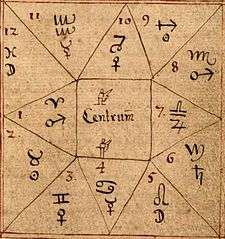
18th century
Icelandic manuscript showing astrological houses and glyphs for planets and signs.
Central to horoscopic astrology and its branches is the calculation of the horoscope or astrological chart. This two-dimensional diagrammatic representation shows the celestial bodies' apparent positions in the heavens from the vantage of a location on Earth at a given time and place. The horoscope is also divided into twelve different celestial
houses which govern different areas of life. Calculations performed in casting a horoscope involve
arithmetic and simple
geometry which serve to locate the apparent position of heavenly bodies on desired dates and times based on astronomical tables. In ancient Hellenistic astrology the ascendant demarcated the first celestial house of a horoscope. The word for the ascendant in Greek was ὡροσκόπος (
hōroskopos) from which
horoscope derives. In modern times, the word has come to refer to the astrological chart as a whole.
Branches
Traditions of horoscopic astrology can be divided into four branches that are each directed towards specific subjects or purposes. Often these branches use a unique set of techniques, or a different application of the core principles of the system to a different area. Many other subsets and applications of astrology are derived from these four fundamental branches.
Natal astrology is the study of a person's natal chart to gain information about the individual and their life experience.
Katarchic astrology includes both
electional and event astrology. The former uses astrology to determine the most auspicious moment to begin an enterprise or undertaking, and the latter to understand everything about an event from the time at which it took place.
Horary astrology is used to answer a specific question by studying the chart of the moment the question is posed to an astrologer.
Mundane or world astrology is the application of astrology to world events, including weather, earthquakes, and the rise and fall of empires or religions. This includes the
Astrological Ages, such as the
Age of Aquarius, Age of Pisces, and so on. Each age is about 2,150 years in length, and many people use these massive ages to characterize and describe major historical ages, as well as current developments in the world.
History
Many believe that the origins of much of the astrological doctrine and method that would later develop in
Asia,
Europe, and the
Middle East are found among the ancient
Babylonians and their system of celestial omens that began to be compiled around the middle of the 2nd millennium BC. They believe this system of celestial omens later spread, either directly or indirectly through the Babylonians and Assyrians, to other areas such as the
Middle East, and
Greece, where it merged with pre-existing indigenous forms of astrology. Thus, Babylonian astrology migrated to Greece, initially as early as the middle of the 4th century BC, and then around the late 2nd or early 1st century BC, after the
Alexandrian conquests, this Babylonian astrology was mixed with the Egyptian tradition of decanic astrology to create
horoscopic astrology. This new form of astrology, which appears to have originated in
Alexandrian Egypt, spread across the ancient world into Europe, the Middle East, and India with varying degrees of influence.
Before the modern era
The differentiation between astronomy and astrology varied from place to place; they were strongly linked in ancient India, ancient Babylonia and
medieval Europe, but separated to an extent in the
Hellenistic world. The first
semantic distinction between
astrology and astronomy was probably given by
Isidore of Seville (see
astrology and astronomy).
The pattern of astronomical knowledge gained from astrological endeavors has been historically repeated across numerous cultures, from
ancient India through the classical
Maya civilization to medieval Europe. Given this historical contribution, astrology has been called a
protoscience along with disciplines such as
alchemy.
Astrology was not without criticism before the modern era; it was often challenged by Hellenistic skeptics, church authorities, and medieval
Muslim astronomers, such as
Al-Farabi (Alpharabius),
Ibn al-Haytham (Alhazen),
Abū Rayhān al-Bīrūnī,
Avicenna and
Averroes. Their reasons for refuting astrology were often due to both scientific (the methods used by astrologers being
conjectural rather than
empirical) and religious (conflicts with orthodox
Islamic scholars) reasons.
Ibn Qayyim Al-Jawziyya (1292–1350), in his
Miftah Dar al-SaCadah, used empirical arguments in astronomy in order to refute astrology and
divination.
Many prominent thinkers, philosophers and scientists, such as
Galen,
Paracelsus,
Girolamo Cardan,
Nicolaus Copernicus,
Taqi al-Din,
Tycho Brahe,
Galileo Galilei,
Johannes Kepler,
Carl Jung and others, practiced or significantly contributed to astrology.
Contemporary changes
Several innovations have occurred in contemporary astrological practice.
Western
During the middle of the 20th century,
Alfred Witte and, following him,
Reinhold Ebertin pioneered the use of midpoints (see
Midpoint (astrology)) in horoscopic analysis. From the 1930s to the 1980s, astrologers including
Dane Rudhyar,
Liz Greene and
Stephen Arroyo pioneered the use of
astrology for psychological analysis, with some following the lead of psychologists like
Carl Jung. In the 1930s,
Don Neroman developed and popularized in Europe a form of
Locational Astrology under the name of "Astrogeography". In the 1970s, American astrologer
Jim Lewis developed and popularized a different approach under the name of
Astrocartography. Both methods purport to identify varying life conditions through differences in location.
Vedic (Hindu astrology)
Indian astrology uses a different
zodiac than
Western astrology and is a branch of
Vedic science. In
India, there is a long-established widespread belief in astrology, and it is commonly used for daily life, foremost with regard to marriages, and secondarily with regard to career and electional and
karmic astrology. In the 1960s,
H.R. Seshadri Iyer, introduced a system including the concepts of yogi and avayogi. It generated interest with research oriented astrologers in the West. From the early 1990s, Indian vedic astrologer and author,
V.K. Choudhry has created and developed the
Systems' Approach for Interpreting Horoscopes, a simplified system of Jyotish (predictive astrology) The system, also known as "SA", helps those who are trying to learn Jyotisha. The late K.S. Krishnamurti developed the Krishnamurti Paddhati system based on the analysis of the stars (
nakshatras), by sub-dividing the stars in the ratio of the
dasha of the concerned planets. The system is also known as "KP" and "sub theory". In 2001, Indian scientists and politicians debated and critiqued a proposal to use state money to fund research into Vedic astrology.
Effects on world culture
Belief in astrology holds firm today in many parts of the world: in one poll, 31% of
Americans expressed a belief in astrology and, according to another study, 39% considered it scientific.
Astrology has had an influence on both language and literature. For example,
influenza, from medieval Latin
influentia meaning influence, was so named because doctors once believed epidemics to be caused by unfavorable planetary and stellar influences. The word "disaster" comes from the Italian
disastro, derived from the negative prefix
dis- and from Latin
aster "star", thus meaning "ill-starred". Adjectives "lunatic" (Luna/
Moon), "mercurial" (
Mercury), "venereal" (
Venus), "martial" (
Mars), "jovial" (
Jupiter/Jove), and "saturnine" (
Saturn) are all old words used to describe personal qualities said to resemble or be highly influenced by the astrological characteristics of the planet, some of which are derived from the attributes of the ancient Roman gods they are named after. In literature, many writers, notably
Geoffrey Chaucer and
William Shakespeare, used astrological symbolism to add subtlety and nuance to the description of their characters' motivation(s). More recently, Michael Ward has proposed that
C.S. Lewis imbued his
Chronicles of Narnia with the characteristics and symbols of the seven heavens. Often, an understanding of astrological symbolism is needed to fully appreciate such literature.
Astrology and science
| Pseudoscientific concepts |
|
| Claims |
| Measurable correlations can be reliably found between the position of the planets and personality and human events. |
| Related scientific disciplines |
| Astronomy, Psychology |
| Year proposed |
| antiquity |
| Original proponents |
| ancient priests and astrologers |
| Subsequent proponents |
| Philip Berg, Michel Gauquelin, Linda Goodman, Liz Greene, Alan Leo, Sydney Omarr, Joan Quigley, Jackie Stallone, Athena Starwoman, Shelley von Strunckel, Richard Tarnas |
In the Islamic world astrology was rejected during the turn of the 2nd millennium AD owing to the development of the scientific method and the work of al-Farabi, Alhacen, al-Biruni, Avicenna and Averroes, who made a semantic distinction between astronomy and astrology and helped to render astrology
obsolete for Muslims.
Muslim views on astrology have generally remained negative.
By the time of
Francis Bacon and the
scientific revolution, newly emerging scientific disciplines acquired a method of systematic empirical induction based upon experimental observations. At this point, astrology and astronomy began to diverge; astronomy became regarded as one of the empirical sciences, while astrology came to be understood as a part of scholastic
metaphysics, and was increasingly viewed as an occult science or superstition by natural scientists. For example,
Christiaan Huygens wrote in his
Cosmotheoros: "And as for the Judicial Astrology, that pretends to foretel what is to come, it is such a ridiculous, and oftentimes mischievous Folly, that I do not think it fit to be so much as named." This separation accelerated through the 18th and 19th centuries.
Contemporary scientists, such as
Richard Dawkins and
Stephen Hawking, regard astrology as unscientific, and those such as
Andrew Fraknoi of the
Astronomical Society of the Pacific have labeled it a pseudoscience. In 1975, the
American Humanist Association characterized those who have faith in astrology as doing so "in spite of the fact that there is no verified scientific basis for their beliefs, and indeed that there is strong evidence to the contrary".
Astronomer
Carl Sagan was unwilling to sign the statement, not because he felt astrology was valid, but because he found the statement's tone
authoritarian. Sagan stated that he would instead have been willing to sign a statement describing and refuting the principal tenets of astrological belief, which he believed would have been more persuasive and would have produced less controversy than the circulated statement.
Astrophysicist Neil deGrasse Tyson asserted that "astrology was discredited 600 years ago with the birth of modern
science. 'To teach it as though you are contributing to the fundamental knowledge of an informed electorate is astonishing in this, the 21st century'. Education should be about knowing how to think, 'And part of knowing how to think is knowing how the laws of nature shape the world around us. Without that knowledge, without that capacity to think, you can easily become a victim of people who seek to take advantage of you
'".
Although astrology has not been considered a science for some time, it has been the subject of considerable research by astrologers since the beginning of the 20th century. In their study of 20th-century research into natal astrology, Geoffrey Dean, a former astrologer who became critical of the field, and coauthors documented this burgeoning research activity performed primarily within the astrological community.
[57]
Research
Studies have repeatedly failed to demonstrate
statistically significant relationships between astrological predictions and
operationally defined outcomes.
Effect size tests of astrology-based
hypotheses conclude that the
mean accuracy of astrological predictions is no greater than what is expected by chance. For example, when testing for
cognitive,
behavioral, physical and other
variables, one study of 2000 astrological "time twins" born within minutes of each other did not show a celestial influence on human characteristics. It has been suggested that other statistical research is often wrongly seen as evidence for astrology due to uncontrolled
artifacts.
Experimental psychologists have suggested that several different psychological phenomena can contribute to perception of astrological accuracy. One, related to
confirmation bias, is that people who are given a set of multiple predictions tend to remember more of the accurate predictions ("hits") than the inaccurate ones ("misses"). Consequently, people tend to recall the set of predictions as being more accurate than it actually was. When astrological predictions turn out to
correspond with some phenomena but not with others, the recollected
integrity of these predictions may stem in part from this phenomenon. A second, called the
Forer effect, is that individuals tend to give high accuracy ratings to descriptions of their personality that are presented to them as tailored specifically for them, but which are in fact vague and general enough to apply to a wide range of people. When predictions use vague language, the appearance that they are specific to the individual may be partially attributable to the Forer effect.
The French psychologist and statistician who devoted his life to the attempt to demonstrate the validity of certain fundamentals of astrology,
Michel Gauquelin, wrote that he had found correlations between some planetary positions and certain human traits such as vocations. Gauquelin's most widely known concept is the
Mars effect, which denotes a correlation between the planet Mars occupying certain positions in the sky more often at the birth of eminent sports champions than at the birth of ordinary people. A similar idea is explored by
Richard Tarnas in his work
Cosmos and Psyche, in which he examines correspondences between planetary alignments and historically significant events and individuals. Since its original publication in 1955, the Mars effect has been the subject of critical studies and
skeptical publications which aim to refute it, and of studies in
fringe journals used to support or expand the original ideas. Gauquelin's research has not received mainstream scientific notice.
Obstacles to research
Astrologers have argued that there are significant obstacles in carrying out scientific research into astrology today, including lack of funding, lack of background in science and statistics by astrologers, and insufficient expertise in astrology by research scientists and skeptics. Some astrologers have argued that few practitioners today pursue scientific testing of astrology because they feel that working with clients on a daily basis provides personal validation for their clients.
Another argument made by astrologers is that most studies of astrology do not reflect the nature of astrological practice and that the
scientific method does not apply to astrology. Some astrology proponents argue that the prevailing attitudes and motives of many opponents of astrology introduce conscious or unconscious bias in the formulation of hypotheses to be tested, the conduct of the tests, and the reporting of results.
Mechanism
Astrologers have not presented consistent explanations of physical mechanisms underlying astrological beliefs, and few modern astrologers believe in a direct causal relationship between heavenly bodies and earthly events. An editorial published by the
Astronomical Society of the Pacific reports no evidence for a scientifically defined mechanism by which celestial objects can influence terrestrial affairs. Researchers have posited
acausal, purely
correlative, relationships between astrological observations and events, such as the theory of
synchronicity proposed by Carl Jung. Others have posited a basis in
divination. Others have argued that empirical correlations stand on their own
epistemologically, and do not need the support of any theory or mechanism. To some observers, and most astrologers, these non-mechanistic concepts raise serious questions about the feasibility of validating astrology through scientific testing, and some have gone so far as to reject the applicability of the scientific method to astrology entirely. Some astrologers, a minority, on the other hand, believe that astrology is amenable to the scientific method, given sufficiently sophisticated analytical methods, and they cite pilot studies to support this view. Consequently, several astrologers have called for or advocated continuing studies of astrology based on statistical validation.


