Astronomy is a natural science that deals with the study of celestial objects (such as stars, planets, comets, nebulae, star clusters and galaxies) and phenomena that originate outside the Earth's atmosphere (such as the cosmic background radiation). It is concerned with the evolution, physics, chemistry, meteorology, and motion of celestial objects, as well as the formation and development of the universe.
Astronomy is one of the oldest sciences. Prehistoric cultures left behind astronomical artifacts such as the Egyptian monuments and Stonehenge, and early civilizations such as the Babylonians, Greeks, Chinese, and Indians performed methodical observations of the night sky. However, the invention of the telescope was required before astronomy was able to develop into a modern science. Historically, astronomy has included disciplines as diverse as astrometry, celestial navigation, observational astronomy, the making of calendars, and even astrology, but professional astronomy is nowadays often considered to be synonymous with astrophysics.
During the 20th century, the field of professional astronomy split into observational and theoretical branches. Observational astronomy is focused on acquiring data from observations of celestial objects, which is then analyzed using basic principles of physics. Theoretical astronomy is oriented towards the development of computer or analytical models to describe astronomical objects and phenomena. The two fields complement each other, with theoretical astronomy seeking to explain the observational results, and observations being used to confirm theoretical results.
Amateur astronomers have contributed to many important astronomical discoveries, and astronomy is one of the few sciences where amateurs can still play an active role, especially in the discovery and observation of transient phenomena.
Ancient astronomy is not to be confused with astrology, the belief system which claims that human affairs are correlated with the positions of celestial objects. Although the two fields share a common origin and a part of their methods (namely, the use of ephemerides), they are distinct.
Lexicology
The word astronomy (from the Greek words astron (ἄστρον), "star" and -nomy from nomos (νόμος), "law" or "culture") literally means "law of the stars" (or "culture of the stars" depending on the translation).
Use of terms "astronomy" and "astrophysics"
Generally, either the term "astronomy" or "astrophysics" may be used to refer to this subject. Based on strict dictionary definitions, "astronomy" refers to "the study of objects and matter outside the Earth's atmosphere and of their physical and chemical properties" and "astrophysics" refers to the branch of astronomy dealing with "the behavior, physical properties, and dynamic processes of celestial objects and phenomena". In some cases, as in the introduction of the introductory textbook The Physical Universe by Frank Shu, "astronomy" may be used to describe the qualitative study of the subject, whereas "astrophysics" is used to describe the physics-oriented version of the subject. However, since most modern astronomical research deals with subjects related to physics, modern astronomy could actually be called astrophysics. Various departments that research this subject may use "astronomy" and "astrophysics", partly depending on whether the department is historically affiliated with a physics department, and many professional astronomers actually have physics degrees. One of the leading scientific journals in the field is named Astronomy and Astrophysics.
History
A celestial map from the 17th century, by the Dutch cartographer Frederik de Wit.
In early times, astronomy only comprised the observation and predictions of the motions of objects visible to the naked eye. In some locations, such as Stonehenge, early cultures assembled massive artifacts that likely had some astronomical purpose. In addition to their ceremonial uses, these observatories could be employed to determine the seasons, an important factor in knowing when to plant crops, as well as in understanding the length of the year.
Before tools such as the telescope were invented early study of the stars had to be conducted from the only vantage points available, namely tall buildings and high ground using the naked eye. As civilizations developed, most notably in Mesopotamia, China, Egypt, Greece, India, and Central America, astronomical observatories were assembled, and ideas on the nature of the universe began to be explored. Most of early astronomy actually consisted of mapping the positions of the stars and planets, a science now referred to as astrometry. From these observations, early ideas about the motions of the planets were formed, and the nature of the Sun, Moon and the Earth in the universe were explored philosophically. The Earth was believed to be the center of the universe with the Sun, the Moon and the stars rotating around it. This is known as the geocentric model of the universe.
A particularly important early development was the beginning of mathematical and scientific astronomy, which began among the Babylonians, who laid the foundations for the later astronomical traditions that developed in many other civilizations.The Babylonians discovered that lunar eclipses recurred in a repeating cycle known as a saros.
Greek equatorial sun dial, Alexandria on the Oxus, present-day Afghanistan 3rd-2nd century BCE.
Following the Babylonians, significant advances in astronomy were made in ancient Greece and the Hellenistic world. Greek astronomy is characterized from the start by seeking a rational, physical explanation for celestial phenomena. In the 3rd century BC, Aristarchus of Samos calculated the size of the Earth, and measured the size and distance of the Moon and Sun, and was the first to propose a heliocentric model of the solar system. In the 2nd century BC, Hipparchus discovered precession, calculated the size and distance of the Moon and invented the earliest known astronomical devices such as the astrolabe. Hipparchus also created a comprehensive catalog of 1020 stars, and most of the constellations of the northern hemisphere derive are taken from Greek astronomy. The Antikythera mechanism (c. 150–80 BC) was an early analog computer designed to calculating the location of the Sun, Moon, and planets for a given date. Technological artifacts of similar complexity did not reappear until the 14th century, when mechanical astronomical clocks appeared in Europe.
During the Middle Ages, astronomy was mostly stagnant in medieval Europe, at least until the 13th century. However, astronomy flourished in the Islamic world and other parts of the world. This led to the emergence of the first astronomical observatories in the Muslim world by the early 9th century. In 964, the Andromeda Galaxy, the nearest galaxy to the Milky Way, was discovered by the Persian astronomer Azophi and first described in his Book of Fixed Stars. The SN 1006 supernova, the brightest apparent magnitude stellar event in recorded history, was observed by the Egyptian Arabic astronomer Ali ibn Ridwan and the Chinese astronomers in 1006. Some of the prominent Islamic (mostly Persian and Arab) astronomers who made significant contributions to the science include Al-Battani, Thebit, Azophi, Albumasar, Biruni, Arzachel, Al-Birjandi, and the astronomers of the Maragheh and Samarkand observatories. Astronomers during that time introduced many Arabic names now used for individual stars. It is also believed that the ruins at Great Zimbabwe and Timbuktu may have housed an astronomical observatory. Europeans had previously believed that there had been no astronomical observation in pre-colonial Middle Ages sub-Saharan Africa but modern discoveries show otherwise.
Scientific revolution
Galileo's sketches and observations of the Moon revealed that the surface was mountainous.
During the Renaissance, Nicolaus Copernicus proposed a heliocentric model of the solar system. His work was defended, expanded upon, and corrected by Galileo Galilei and Johannes Kepler. Galileo innovated by using telescopes to enhance his observations.
Kepler was the first to devise a system that described correctly the details of the motion of the planets with the Sun at the center. However, Kepler did not succeed in formulating a theory behind the laws he wrote down. It was left to Newton's invention of celestial dynamics and his law of gravitation to finally explain the motions of the planets. Newton also developed the reflecting telescope.
Further discoveries paralleled the improvements in the size and quality of the telescope. More extensive star catalogues were produced by Lacaille. The astronomer William Herschel made a detailed catalog of nebulosity and clusters, and in 1781 discovered the planet Uranus, the first new planet found. The distance to a star was first announced in 1838 when the parallax of 61 Cygni was measured by Friedrich Bessel.
During the 18–19th centuries, attention to the three body problem by Euler, Clairaut, and D'Alembert led to more accurate predictions about the motions of the Moon and planets. This work was further refined by Lagrange and Laplace, allowing the masses of the planets and moons to be estimated from their perturbations.
Significant advances in astronomy came about with the introduction of new technology, including the spectroscope and photography. Fraunhofer discovered about 600 bands in the spectrum of the Sun in 1814–15, which, in 1859, Kirchhoff ascribed to the presence of different elements. Stars were proven to be similar to the Earth's own Sun, but with a wide range of temperatures, masses, and sizes.
The existence of the Earth's galaxy, the Milky Way, as a separate group of stars, was only proved in the 20th century, along with the existence of "external" galaxies, and soon after, the expansion of the Universe, seen in the recession of most galaxies from us. Modern astronomy has also discovered many exotic objects such as quasars, pulsars, blazars, and radio galaxies, and has used these observations to develop physical theories which describe some of these objects in terms of equally exotic objects such as black holes and neutron stars. Physical cosmology made huge advances during the 20th century, with the model of the Big Bang heavily supported by the evidence provided by astronomy and physics, such as the cosmic microwave background radiation, Hubble's law, and cosmological abundances of elements.
Observational astronomy
The Very Large Array in New Mexico, an example of a radio telescope
Main article: Observational astronomy
In astronomy, the main source of information about celestial bodies and other objects is the visible light or more generally electromagnetic radiation. Observational astronomy may be divided according to the observed region of the electromagnetic spectrum. Some parts of the spectrum can be observed from the Earth's surface, while other parts are only observable from either high altitudes or space. Specific information on these subfields is given below.
Radio astronomy
Radio astronomy studies radiation with wavelengths greater than approximately one millimeter. Radio astronomy is different from most other forms of observational astronomy in that the observed radio waves can be treated as waves rather than as discrete photons. Hence, it is relatively easier to measure both the amplitude and phase of radio waves, whereas this is not as easily done at shorter wavelengths.
Although some radio waves are produced by astronomical objects in the form of thermal emission, most of the radio emission that is observed from Earth is seen in the form of synchrotron radiation, which is produced when electrons oscillate around magnetic fields. Additionally, a number of spectral lines produced by interstellar gas, notably the hydrogen spectral line at 21 cm, are observable at radio wavelengths.
A wide variety of objects are observable at radio wavelengths, including supernovae, interstellar gas, pulsars, and active galactic nuclei.
Infrared astronomy
Main article: Infrared astronomy
Infrared astronomy deals with the detection and analysis of infrared radiation (wavelengths longer than red light). Except at wavelengths close to visible light, infrared radiation is heavily absorbed by the atmosphere, and the atmosphere produces significant infrared emission. Consequently, infrared observatories have to be located in high, dry places or in space. The infrared spectrum is useful for studying objects that are too cold to radiate visible light, such as planets and circumstellar disks. Longer infrared wavelengths can also penetrate clouds of dust that block visible light, allowing observation of young stars in molecular clouds and the cores of galaxies. Some molecules radiate strongly in the infrared. This can be used to study chemistry in space; more specifically it can detect water in comets.
Optical astronomy
The Subaru Telescope (left) and Keck Observatory (center) on Mauna Kea, both examples of an observatory that operates at near-infrared and visible wavelengths. The NASA Infrared Telescope Facility (right) is an example of a telescope that operates only at near-infrared wavelengths.
Main article: Optical astronomy
Historically, optical astronomy, also called visible light astronomy, is the oldest form of astronomy. Optical images were originally drawn by hand. In the late 19th century and most of the 20th century, images were made using photographic equipment. Modern images are made using digital detectors, particularly detectors using charge-coupled devices (CCDs). Although visible light itself extends from approximately 4000 Å to 7000 Å (400 nm to 700 nm), the same equipment used at these wavelengths is also used to observe some near-ultraviolet and near-infrared radiation.
Ultraviolet astronomy
Main article: Ultraviolet astronomy
Ultraviolet astronomy is generally used to refer to observations at ultraviolet wavelengths between approximately 100 and 3200 Å (10 to 320 nm). Light at these wavelengths is absorbed by the Earth's atmosphere, so observations at these wavelengths must be performed from the upper atmosphere or from space. Ultraviolet astronomy is best suited to the study of thermal radiation and spectral emission lines from hot blue stars (OB stars) that are very bright in this wave band. This includes the blue stars in other galaxies, which have been the targets of several ultraviolet surveys. Other objects commonly observed in ultraviolet light include planetary nebulae, supernova remnants, and active galactic nuclei. However, as ultraviolet light is easily absorbed by interstellar dust, an appropriate adjustment of ultraviolet measurements is necessary.
X-ray astronomy
Main article: X-ray astronomy
X-ray astronomy is the study of astronomical objects at X-ray wavelengths. Typically, objects emit X-ray radiation as synchrotron emission (produced by electrons oscillating around magnetic field lines), thermal emission from thin gases above 107 (10 million) kelvins, and thermal emission from thick gases above 107 Kelvin.[33] Since X-rays are absorbed by the Earth's atmosphere, all X-ray observations must be performed from high-altitude balloons, rockets, or spacecraft. Notable X-ray sources include X-ray binaries, pulsars, supernova remnants, elliptical galaxies, clusters of galaxies, and active galactic nuclei.
According to NASA's official website, X-rays were first observed and documented in 1895 by Wilhelm Conrad Röntgen, a German scientist who found them quite by accident when experimenting with vacuum tubes. Through a series of experiments, including the infamous X-ray photograph he took of his wife's hand with a wedding ring on it, Röntgen was able to discover the beginning elements of radiation. The "X", in fact, holds its own significance, as it represents Röntgen's inability to identify exactly what type of radiation it was.
Furthermore, according to the website, in some German speaking countries, X-rays are still sometimes referred to as Röntgen rays, in honor of the man who discovered them.
Gamma-ray astronomy
Main article: Gamma ray astronomy
Gamma ray astronomy is the study of astronomical objects at the shortest wavelengths of the electromagnetic spectrum. Gamma rays may be observed directly by satellites such as the Compton Gamma Ray Observatory or by specialized telescopes called atmospheric Cherenkov telescopes. The Cherenkov telescopes do not actually detect the gamma rays directly but instead detect the flashes of visible light produced when gamma rays are absorbed by the Earth's atmosphere.
Most gamma-ray emitting sources are actually gamma-ray bursts, objects which only produce gamma radiation for a few milliseconds to thousands of seconds before fading away. Only 10% of gamma-ray sources are non-transient sources. These steady gamma-ray emitters include pulsars, neutron stars, and black hole candidates such as active galactic nuclei.
Fields not based on the electromagnetic spectrum
In addition to electromagnetic radiation, a few other events originating from great distances may be observed from the Earth.
In neutrino astronomy, astronomers use special underground facilities such as SAGE, GALLEX, and Kamioka II/III for detecting neutrinos. These neutrinos originate primarily from the Sun but also from supernovae. Cosmic rays, which consist of very high energy particles that can decay or be absorbed when they enter the Earth's atmosphere, result in a cascade of particles which can be detected by current observatories. Additionally, some future neutrino detectors may also be sensitive to the particles produced when cosmic rays hit the Earth's atmosphere. Gravitational wave astronomy is an emerging new field of astronomy which aims to use gravitational wave detectors to collect observational data about compact objects. A few observatories have been constructed, such as the Laser Interferometer Gravitational Observatory LIGO, but gravitational waves are extremely difficult to detect.
Planetary astronomers have directly observed many of these phenomena through spacecraft and sample return missions. These observations include fly-by missions with remote sensors, landing vehicles that can perform experiments on the surface materials, impactors that allow remote sensing of buried material, and sample return missions that allow direct laboratory examination.
Astrometry and celestial mechanics
Main articles: Astrometry and Celestial mechanics
One of the oldest fields in astronomy, and in all of science, is the measurement of the positions of celestial objects. Historically, accurate knowledge of the positions of the Sun, Moon, planets and stars has been essential in celestial navigation and in the making of calendars.
Careful measurement of the positions of the planets has led to a solid understanding of gravitational perturbations, and an ability to determine past and future positions of the planets with great accuracy, a field known as celestial mechanics. More recently the tracking of near-Earth objects will allow for predictions of close encounters, and potential collisions, with the Earth.
The measurement of stellar parallax of nearby stars provides a fundamental baseline in the cosmic distance ladder that is used to measure the scale of the universe. Parallax measurements of nearby stars provide an absolute baseline for the properties of more distant stars, because their properties can be compared. Measurements of radial velocity and proper motion show the kinematics of these systems through the Milky Way galaxy. Astrometric results are also used to measure the distribution of dark matter in the galaxy.
During the 1990s, the astrometric technique of measuring the stellar wobble was used to detect large extrasolar planets orbiting nearby stars.
Theoretical astronomy
Nucleosynthesis
Wpdms physics proton proton chain 1.svg
* Stellar nucleosynthesis
* Big Bang nucleosynthesis
* Supernova nucleosynthesis
* Cosmic ray spallation
Related topics
* Astrophysics
* Nuclear fusion
o R-process
o S-process
* Nuclear fission
edit
Main article: Theoretical astronomy
Theoretical astronomers use a wide variety of tools which include analytical models (for example, polytropes to approximate the behaviors of a star) and computational numerical simulations. Each has some advantages. Analytical models of a process are generally better for giving insight into the heart of what is going on. Numerical models can reveal the existence of phenomena and effects that would otherwise not be seen.
Theorists in astronomy endeavor to create theoretical models and figure out the observational consequences of those models. This helps observers look for data that can refute a model or help in choosing between several alternate or conflicting models.
Theorists also try to generate or modify models to take into account new data. In the case of an inconsistency, the general tendency is to try to make minimal modifications to the model to fit the data. In some cases, a large amount of inconsistent data over time may lead to total abandonment of a model.
Topics studied by theoretical astronomers include: stellar dynamics and evolution; galaxy formation; large-scale structure of matter in the Universe; origin of cosmic rays; general relativity and physical cosmology, including string cosmology and astroparticle physics. Astrophysical relativity serves as a tool to gauge the properties of large scale structures for which gravitation plays a significant role in physical phenomena investigated and as the basis for black hole (astro)physics and the study of gravitational waves.
Some widely accepted and studied theories and models in astronomy, now included in the Lambda-CDM model are the Big Bang, Cosmic inflation, dark matter, and fundamental theories of physics.
A few examples of this process:
Physical process Experimental tool Theoretical model Explains/predicts
Gravitation Radio telescopes Self-gravitating system Emergence of a star system
Nuclear fusion Spectroscopy Stellar evolution How the stars shine and how metals formed
The Big Bang Hubble Space Telescope, COBE Expanding universe Age of the Universe
Quantum fluctuations
Cosmic inflation Flatness problem
Gravitational collapse X-ray astronomy General relativity Black holes at the center of Andromeda galaxy
CNO cycle in stars
Dark matter and dark energy are the current leading topics in astronomy, as their discovery and controversy originated during the study of the galaxies.
Specific subfields
Solar astronomy
An ultraviolet image of the Sun's active photosphere as viewed by the TRACE space telescope. NASA photo
Main article: Sun
At a distance of about eight light-minutes, the most frequently studied star is the Sun, a typical main-sequence dwarf star of stellar class G2 V, and about 4.6 Gyr in age. The Sun is not considered a variable star, but it does undergo periodic changes in activity known as the sunspot cycle. This is an 11-year fluctuation in sunspot numbers. Sunspots are regions of lower-than- average temperatures that are associated with intense magnetic activity.
The Sun has steadily increased in luminosity over the course of its life, increasing by 40% since it first became a main-sequence star. The Sun has also undergone periodic changes in luminosity that can have a significant impact on the Earth. The Maunder minimum, for example, is believed to have caused the Little Ice Age phenomenon during the Middle Ages.
The visible outer surface of the Sun is called the photosphere. Above this layer is a thin region known as the chromosphere. This is surrounded by a transition region of rapidly increasing temperatures, then by the super-heated corona.
At the center of the Sun is the core region, a volume of sufficient temperature and pressure for nuclear fusion to occur. Above the core is the radiation zone, where the plasma conveys the energy flux by means of radiation. The outer layers form a convection zone where the gas material transports energy primarily through physical displacement of the gas. It is believed that this convection zone creates the magnetic activity that generates sun spots.
A solar wind of plasma particles constantly streams outward from the Sun until it reaches the heliopause. This solar wind interacts with the magnetosphere of the Earth to create the Van Allen radiation belts, as well as the aurora where the lines of the Earth's magnetic field descend into the atmosphere.
Planetary science
Main articles: Planetary science and Planetary geology
This astronomical field examines the assemblage of planets, moons, dwarf planets, comets, asteroids, and other bodies orbiting the Sun, as well as extrasolar planets. The solar system has been relatively well-studied, initially through telescopes and then later by spacecraft. This has provided a good overall understanding of the formation and evolution of this planetary system, although many new discoveries are still being made.
The black spot at the top is a dust devil climbing a crater wall on Mars. This moving, swirling column of Martian atmosphere (comparable to a terrestrial tornado) created the long, dark streak. NASA image.
The solar system is subdivided into the inner planets, the asteroid belt, and the outer planets. The inner terrestrial planets consist of Mercury, Venus, Earth, and Mars. The outer gas giant planets are Jupiter, Saturn, Uranus, and Neptune.Beyond Neptune lies the Kuiper Belt, and finally the Oort Cloud, which may extend as far as a light-year.
The planets were formed in the protoplanetary disk that surrounded the early Sun. Through a process that included gravitational attraction, collision, and accretion, the disk formed clumps of matter that, with time, became protoplanets. The radiation pressure of the solar wind then expelled most of the unaccreted matter, and only those planets with sufficient mass retained their gaseous atmosphere. The planets continued to sweep up, or eject, the remaining matter during a period of intense bombardment, evidenced by the many impact craters on the Moon. During this period, some of the protoplanets may have collided, the leading hypothesis for how the Moon was formed.
Once a planet reaches sufficient mass, the materials with different densities segregate within, during planetary differentiation. This process can form a stony or metallic core, surrounded by a mantle and an outer surface. The core may include solid and liquid regions, and some planetary cores generate their own magnetic field, which can protect their atmospheres from solar wind stripping.
A planet or moon's interior heat is produced from the collisions that created the body, radioactive materials (e.g. uranium, thorium, and Al), or tidal heating. Some planets and moons accumulate enough heat to drive geologic processes such as volcanism and tectonics. Those that accumulate or retain an atmosphere can also undergo surface erosion from wind or water. Smaller bodies, without tidal heating, cool more quickly; and their geological activity ceases with the exception of impact cratering.Stellar astronomy
The Ant planetary nebula. Ejecting gas from the dying central star shows symmetrical patterns unlike the chaotic patterns of ordinary explosions.
Main article: Star
The study of stars and stellar evolution is fundamental to our understanding of the universe. The astrophysics of stars has been determined through observation and theoretical understanding; and from computer simulations of the interior.
Star formation occurs in dense regions of dust and gas, known as giant molecular clouds. When destabilized, cloud fragments can collapse under the influence of gravity, to form a protostar. A sufficiently dense, and hot, core region will trigger nuclear fusion, thus creating a main-sequence star.
Almost all elements heavier than hydrogen and helium were created inside the cores of stars.
The characteristics of the resulting star depend primarily upon its starting mass. The more massive the star, the greater its luminosity, and the more rapidly it expends the hydrogen fuel in its core. Over time, this hydrogen fuel is completely converted into helium, and the star begins to evolve. The fusion of helium requires a higher core temperature, so that the star both expands in size, and increases in core density. The resulting red giant enjoys a brief life span, before the helium fuel is in turn consumed. Very massive stars can also undergo a series of decreasing evolutionary phases, as they fuse increasingly heavier elements.
The final fate of the star depends on its mass, with stars of mass greater than about eight times the Sun becoming core collapse supernovae; while smaller stars form planetary nebulae, and evolve into white dwarfs.The remnant of a supernova is a dense neutron star, or, if the stellar mass was at least three times that of the Sun, a black hole. Close binary stars can follow more complex evolutionary paths, such as mass transfer onto a white dwarf companion that can potentially cause a supernova.Planetary nebulae and supernovae are necessary for the distribution of metals to the interstellar medium; without them, all new stars (and their planetary systems) would be formed from hydrogen and helium alone.
Galactic astronomy
Observed structure of the Milky Way's spiral arms
Our solar system orbits within the Milky Way, a barred spiral galaxy that is a prominent member of the Local Group of galaxies. It is a rotating mass of gas, dust, stars and other objects, held together by mutual gravitational attraction. As the Earth is located within the dusty outer arms, there are large portions of the Milky Way that are obscured from view.
In the center of the Milky Way is the core, a bar-shaped bulge with what is believed to be a supermassive black hole at the center. This is surrounded by four primary arms that spiral from the core. This is a region of active star formation that contains many younger, population I stars. The disk is surrounded by a spheroid halo of older, population II stars, as well as relatively dense concentrations of stars known as globular clusters.
Between the stars lies the interstellar medium, a region of sparse matter. In the densest regions, molecular clouds of molecular hydrogen and other elements create star-forming regions. These begin as a compact pre-stellar core or dark nebulae, which concentrate and collapse (in volumes determined by the Jeans length) to form compact protostars.
As the more massive stars appear, they transform the cloud into an H II region of glowing gas and plasma. The stellar wind and supernova explosions from these stars eventually serve to disperse the cloud, often leaving behind one or more young open clusters of stars. These clusters gradually disperse, and the stars join the population of the Milky Way.
Kinematic studies of matter in the Milky Way and other galaxies have demonstrated that there is more mass than can be accounted for by visible matter. A dark matter halo appears to dominate the mass, although the nature of this dark matter remains undetermined.
Extragalactic astronomy
This image shows several blue, loop-shaped objects that are multiple images of the same galaxy, duplicated by the gravitational lens effect of the cluster of yellow galaxies near the middle of the photograph. The lens is produced by the cluster's gravitational field that bends light to magnify and distort the image of a more distant object.
The study of objects outside our galaxy is a branch of astronomy concerned with the formation and evolution of Galaxies; their morphology and classification; and the examination of active galaxies, and the groups and clusters of galaxies. The latter is important for the understanding of the large-scale structure of the cosmos.
Most galaxies are organized into distinct shapes that allow for classification schemes. They are commonly divided into spiral, elliptical and Irregular galaxies.
As the name suggests, an elliptical galaxy has the cross-sectional shape of an ellipse. The stars move along random orbits with no preferred direction. These galaxies contain little or no interstellar dust; few star-forming regions; and generally older stars. Elliptical galaxies are more commonly found at the core of galactic clusters, and may be formed through mergers of large galaxies.
A spiral galaxy is organized into a flat, rotating disk, usually with a prominent bulge or bar at the center, and trailing bright arms that spiral outward. The arms are dusty regions of star formation where massive young stars produce a blue tint. Spiral galaxies are typically surrounded by a halo of older stars. Both the Milky Way and the Andromeda Galaxy are spiral galaxies.
Irregular galaxies are chaotic in appearance, and are neither spiral nor elliptical. About a quarter of all galaxies are irregular, and the peculiar shapes of such galaxies may be the result of gravitational interaction.
An active galaxy is a formation that is emitting a significant amount of its energy from a source other than stars, dust and gas; and is powered by a compact region at the core, usually thought to be a super-massive black hole that is emitting radiation from in-falling material.
A radio galaxy is an active galaxy that is very luminous in the radio portion of the spectrum, and is emitting immense plumes or lobes of gas. Active galaxies that emit high-energy radiation include Seyfert galaxies, Quasars, and Blazars. Quasars are believed to be the most consistently luminous objects in the known universe.
The large-scale structure of the cosmos is represented by groups and clusters of galaxies. This structure is organized in a hierarchy of groupings, with the largest being the superclusters. The collective matter is formed into filaments and walls, leaving large voids in between.
Cosmology
Main article: Physical cosmology
Cosmology (from the Greek κόσμος "world, universe" and λόγος "word, study") could be considered the study of the universe as a whole.
Observations of the large-scale structure of the universe, a branch known as physical cosmology, have provided a deep understanding of the formation and evolution of the cosmos. Fundamental to modern cosmology is the well-accepted theory of the big bang, wherein our universe began at a single point in time, and thereafter expanded over the course of 13.7 Gyr to its present condition. The concept of the big bang can be traced back to the discovery of the microwave background radiation in 1965.
In the course of this expansion, the universe underwent several evolutionary stages. In the very early moments, it is theorized that the universe experienced a very rapid cosmic inflation, which homogenized the starting conditions. Thereafter, nucleosynthesis produced the elemental abundance of the early universe.
When the first atoms formed, space became transparent to radiation, releasing the energy viewed today as the microwave background radiation. The expanding universe then underwent a Dark Age due to the lack of stellar energy sources.
A hierarchical structure of matter began to form from minute variations in the mass density. Matter accumulated in the densest regions, forming clouds of gas and the earliest stars. These massive stars triggered the reionization process and are believed to have created many of the heavy elements in the early universe which tend to decay back to the lighter elements extending the cycle.
Gravitational aggregations clustered into filaments, leaving voids in the gaps. Gradually, organizations of gas and dust merged to form the first primitive galaxies. Over time, these pulled in more matter, and were often organized into groups and clusters of galaxies, then into larger-scale superclusters.
Fundamental to the structure of the universe is the existence of dark matter and dark energy. These are now thought to be the dominant components, forming 96% of the mass of the universe. For this reason, much effort is expended in trying to understand the physics of these components.
Interdisciplinary studies
Astronomy and astrophysics have developed significant interdisciplinary links with other major scientific fields. Archaeoastronomy is the study of ancient or traditional astronomies in their cultural context, utilizing archaeological and anthropological evidence. Astrobiology is the study of the advent and evolution of biological systems in the universe, with particular emphasis on the possibility of non-terrestrial life.
The study of chemicals found in space, including their formation, interaction and destruction, is called astrochemistry. These substances are usually found in molecular clouds, although they may also appear in low temperature stars, brown dwarfs and planets. Cosmochemistry is the study of the chemicals found within the Solar System, including the origins of the elements and variations in the isotope ratios. Both of these fields represent an overlap of the disciplines of astronomy and chemistry. As "forensic astronomy", finally, methods from astronomy have been used to solve problems of law and history.
Amateur astronomy
Amateur astronomers can build their own equipment, and can hold star parties and gatherings, such as Stellafane.
Astronomy is one of the sciences to which amateurs can contribute the most.
Collectively, amateur astronomers observe a variety of celestial objects and phenomena sometimes with equipment that they build themselves. Common targets of amateur astronomers include the Moon, planets, stars, comets, meteor showers, and a variety of deep-sky objects such as star clusters, galaxies, and nebulae. One branch of amateur astronomy, amateur astrophotography, involves the taking of photos of the night sky. Many amateurs like to specialize in the observation of particular objects, types of objects, or types of events which interest them.
Most amateurs work at visible wavelengths, but a small minority experiment with wavelengths outside the visible spectrum. This includes the use of infrared filters on conventional telescopes, and also the use of radio telescopes. The pioneer of amateur radio astronomy was Karl Jansky, who started observing the sky at radio wavelengths in the 1930s. A number of amateur astronomers use either homemade telescopes or use radio telescopes which were originally built for astronomy research but which are now available to amateurs (e.g. the One-Mile Telescope).
Amateur astronomers continue to make scientific contributions to the field of astronomy. Indeed, it is one of the few scientific disciplines where amateurs can still make significant contributions. Amateurs can make occultation measurements that are used to refine the orbits of minor planets. They can also discover comets, and perform regular observations of variable stars. Improvements in digital technology have allowed amateurs to make impressive advances in the field of astrophotography.
Major problems
Although the scientific discipline of astronomy has made tremendous strides in understanding the nature of the universe and its contents, there remain some important unanswered questions. Answers to these may require the construction of new ground- and space-based instruments, and possibly new developments in theoretical and experimental physics.
* What is the origin of the stellar mass spectrum? That is, why do astronomers observe the same distribution of stellar masses – the initial mass function – apparently regardless of the initial conditions? A deeper understanding of the formation of stars and planets is needed.
* Is there other life in the Universe? Especially, is there other intelligent life? If so, what is the explanation for the Fermi paradox? The existence of life elsewhere has important scientific and philosophical implications. Is the Solar System normal or atypical?What caused the Universe to form? Is the premise of the Fine-tuned universe hypothesis correct? If so, could this be the result of cosmological natural selection? What caused the cosmic inflation that produced our homogeneous universe? Why is there a baryon asymmetry?
* What is the nature of dark matter and dark energy? These dominate the evolution and fate of the cosmos, yet their true nature remains unknown. What will be the ultimate fate of the universe?
* How did the first galaxies form? How did supermassive black holes form?
* What is creating the ultra-high-energy cosmic rays?
International Year of Astronomy 2009
During the 62nd General Assembly of the UN, 2009 was declared to be the International Year of Astronomy (IYA2009), with the resolution being made official on 20 December 2008. A global scheme laid out by the International Astronomical Union (IAU), it was also endorsed by UNESCO – the UN body responsible for Educational, Scientific and Cultural matters. IYA2009 was intended to be a global celebration of astronomy and its contributions to society and culture, stimulating worldwide interest not only in astronomy but science in general, with a particular slant towards young people.
Sunday, September 19, 2010

Astrodynamics
Orbital mechanics or astrodynamics is the application of ballistics and celestial mechanics to the practical problems concerning the motion of rockets and other spacecraft. The motion of these objects is usually calculated from Newton's laws of motion and Newton's law of universal gravitation. It is a core discipline within space mission design and control. Celestial mechanics treats more broadly the orbital dynamics of systems under the influence of gravity, including both spacecraft and natural astronomical bodies such as star systems, planets, moons, and comets. Orbital mechanics focuses on spacecraft trajectories, including orbital maneuvers, orbit plane changes, and interplanetary transfers, and is used by mission planners to predict the results of propulsive maneuvers. General relativity is a more exact theory than Newton's laws for calculating orbits, and is sometimes necessary for greater accuracy or in high-gravity situations (such as orbits close to the Sun).
History
Until the rise of space travel in the twentieth century, there was little distinction between orbital and celestial mechanics. The fundamental techniques, such as those used to solve the Keplerian problem (determining position as a function of time), are therefore the same in both fields. Furthermore, the history of the fields is almost entirely shared.
Johannes Kepler was the first to successfully model planetary orbits to a high degree of accuracy, publishing his laws in 1605. Isaac Newton published more general laws of celestial motion in his 1687 book, Philosophiæ Naturalis Principia Mathematica.
Practical techniques
Further information: List of orbits
Rules of thumb
The following rules of thumb are useful for situations approximated by classical mechanics under the standard assumptions of astrodynamics. The specific example discussed is of a satellite orbiting a planet, but the rules of thumb could also apply to other situations, such as orbits of small bodies around a star such as the Sun.
* Kepler's laws of planetary motion, which can be mathematically derived from Newton's laws, hold strictly only in describing the motion of two gravitating bodies, in the absence of non-gravitational forces, or approximately when the gravity of a single massive body like the Sun dominates other effects:
o Orbits are elliptical, with the planet at one focus of the ellipse. Special cases of this are circular orbits (a circle being simply an ellipse of zero eccentricity) with the planet at the center, and parabolic orbits (which are ellipses with eccentricity of exactly 1, which is simply an infinitely long ellipse) with the planet at the focus.
o A line drawn from the planet to the satellite sweeps out equal areas in equal times no matter which portion of the orbit is measured.
o The square of a satellite's orbital period is proportional to the cube of its average distance from the planet.
* Without firing a rocket engine (generating thrust), the height and shape of the satellite's orbit won't change, and it will maintain the same orientation with respect to the fixed stars.
* A satellite in a low orbit (or low part of an elliptical orbit) moves more quickly with respect to the surface of the planet than a satellite in a higher orbit (or a high part of an elliptical orbit), due to the stronger gravitational attraction closer to the planet.
* If a brief rocket firing is made at only one point in the satellite's orbit, it will return to that same point on each subsequent orbit, though the rest of its path will change. Thus to move from one circular orbit to another, at least two brief firings are needed.
* From a circular orbit, a brief firing of a rocket in the direction which slows the satellite down, will create an elliptical orbit with a lower periapse (lowest orbital point) at 180 degrees away from the firing point, which will be the apoapse (highest orbital point). If the rocket is fired to speed the rocket, it will create an elliptical orbit with a higher apoapse 180 degrees away from the firing point (which will become the periapse).
The consequences of the rules of orbital mechanics are sometimes counter-intuitive. For example, if two spacecraft are in the same circular orbit and wish to dock, unless they are very close, the trailing craft cannot simply fire its engines to go faster. This will change the shape of its orbit, causing it to gain altitude and miss its target. One approach is to actually fire a reverse thrust to slow down, and then fire again to re-circularize the orbit at a lower altitude. Because lower orbits are faster than higher orbits, the trailing craft will begin to catch up. A third firing at the right time will put the trailing craft in an elliptical orbit which will intersect the path of the leading craft, approaching from below.
To the degree that the standard assumptions of astrodynamics do not hold, actual trajectories will vary from those calculated. For example, simple atmospheric drag is another complicating factor for objects in Earth orbit. These rules of thumb are decidedly inaccurate when describing two or more bodies of similar mass, such as a binary star system (see n-body problem). (Celestial mechanics uses more general rules applicable to a wider variety of situations.) The differences between classical mechanics and general relativity can also become important for large objects like planets.
Transfer orbits
Transfer orbits allow spacecraft to move from one orbit to another. Usually they require a burn at the start, a burn at the end, and sometimes one or more burns in the middle.
* Hohmann transfer orbit requires little delta-v
* Bi-elliptic transfers sometimes require less
* For faster transfers, any orbit that intersects both the original orbit and destination orbit may be used.
Gravity assist and the Oberth effect
In a gravity assist, a spacecraft swings by a planet and leaves in a different direction, at a different speed. This is useful to speed or slow a spacecraft instead of carrying more fuel.
This maneuver can be approximated by an elastic collision at large distances, though the flyby does not involve any physical contact. Due to Newton's Third Law (equal and opposite reaction), any momentum gained by a spacecraft must be lost by the planet, or vice versa. However, because the planet is much, much more massive than the spacecraft, the effect on the planet's orbit is negligible.
The Oberth effect can be employed, particularly during a gravity assist operation. This effect is that use of a propulsion system works better at high speeds, and hence course changes are best done when close to a gravitating body; this can multiply the effective delta-v.
Interplanetary Transport Network and fuzzy orbits
Main article: Interplanetary Transport Network
See also: Low energy transfers
It is now possible to use computers to search for routes using the nonlinearities in the gravity of the planets and moons of the solar system. For example, it is possible to plot an orbit from high earth orbit to Mars, passing close to one of the Earth's Trojan points. Collectively referred to as the Interplanetary Transport Network, these highly perturbative, even chaotic, orbital trajectories in principle need no fuel (in practice keeping to the trajectory requires some course corrections). The biggest problem with them is they can be exceedingly slow, taking many years to arrive. In addition launch windows can be very far apart.
They have, however, been employed on projects such as Genesis. This spacecraft visited Earth's Lagrange L1 point and returned using very little propellant.
Laws of astrodynamics
The fundamental laws of astrodynamics are Newton's law of universal gravitation and Newton's laws of motion, while the fundamental mathematical tool is his differential calculus.
Every orbit and trajectory outside atmospheres is in principle reversible, i.e., in the space-time function the time is reversed. The velocities are reversed and the accelerations are the same, including those due to rockets bursts. Thus if a rocket burst is in the direction of the velocity, in the reversed case it is opposite to the velocity. Of course in the case of rocket bursts there is no full reversal of events, both ways the same delta-v is used and the same mass ratio applies.
Standard assumptions in astrodynamics include non-interference from outside bodies, negligible mass for one of the bodies, and negligible other forces (such as from the solar wind, atmospheric drag, etc.). More accurate calculations can be made without these simplifying assumptions, but they are more complicated. The increased accuracy often does not make enough of a difference in the calculation to be worthwhile.
Kepler's laws of planetary motion may be derived from Newton's laws, when it is assumed that the orbiting body is subject only to the gravitational force of the central attractor. When an engine thrust or propulsive force is present, Newton's laws still apply, but Kepler's laws are invalidated. When the thrust stops, the resulting orbit will be different but will once again be described by Kepler's laws. The three laws are:
1. The orbit of every planet is an ellipse with the sun at one of the foci.
2. A line joining a planet and the sun sweeps out equal areas during equal intervals of time.
3. The squares of the orbital periods of planets are directly proportional to the cubes of the semi-major axis of the orbits.
Escape velocity
The formula for escape velocity is easily derived as follows. The specific energy (energy per unit mass) of any space vehicle is composed of two components, the specific potential energy and the specific kinetic energy. The specific potential energy associated with a planet of mass M is given by
- G M / r \,
while the specific kinetic energy of an object is given by
v^2/2 \,
Since energy is conserved, the total specific orbital energy
v^2/2 - G M / r \,
does not depend on the distance, r, from the center of the central body to the space vehicle in question. Therefore, the object can reach infinite r only if this quantity is nonnegative, which implies
v\geq\sqrt{2 G M / r}
The escape velocity from the Earth's surface is about 11 km/s, but that is insufficient to send the body an infinite distance because of the gravitational pull of the Sun. To escape the solar system from a location at a distance from the Sun equal to the distance Sun-Earth, but not close to the Earth, requires around 42 km/s velocity, but there will be "part credit" for the Earth's orbital velocity for spacecraft launched from Earth, if their further acceleration (due to the propulsion system) carries them in the same direction as Earth travels in its orbit.
Formulae for free orbits
Orbits are conic sections, so, naturally, the formulas for the distance of a body for a given angle corresponds to the formula for that curve in polar coordinates, which is:
r = \frac{ p }{1 + e \cos \theta}
\mu= G(m_1+m_2)\,
p=h^2/\mu\,
where μ is called the gravitational parameter, G is the gravitational constant, m1 and m2 are the masses of objects 1 and 2, and h is the angular momentum of object 2 with respect to object 1. The parameter θ is known as the true anomaly, p is the semi-latus rectum, while e is the orbital eccentricity, all obtainable from the various forms of the six independent orbital elements.
Circular orbits
All bounded orbits where the gravity of a central body dominates are elliptical in nature. A special case of this is the circular orbit, which is an ellipse of zero eccentricity. The formula for the velocity of a body in a circular orbit at distance r from the center of gravity of mass M is
\ v = \sqrt{\frac{GM} {r}\ }
where G is the gravitational constant, equal to
6.672 598 × 10−11 m3/(kg·s2)
To properly use this formula, the units must be consistent; for example, M must be in kilograms, and r must be in meters. The answer will be in meters per second.
The quantity GM is often termed the standard gravitational parameter, which has a different value for every planet or moon in the solar system.
Once the circular orbital velocity is known, the escape velocity is easily found by multiplying by the square root of 2:
\ v = \sqrt 2\sqrt{\frac {GM} {r}\ } = \sqrt{\frac {2GM} {r}\ }.
Elliptical Orbits
If 0<e<1, then the denominator of the equation of free orbits varies with the true anomaly θ, but remains positive, never becoming zero. Therefore, the relative position vector remains bounded, having its smallest magnitude at periapsis rp which is given by:
r_p=\frac{p}{1+e}
The maximum value r is reached when θ = 180. This point is called the apoapsis, and its radial coordinate, denoted ra, is
r_a=\frac{p}{1-e}
Let 2a be the distance measured along the apse line from periapsis P to apoapsis A, as illustrated in the equation below:
2a = rp + ra
Substituting the equations above, we get:
a=\frac{p}{1-e^2}
a is the semimajor axis of the ellipse. Solving for r we get:
r=\frac{a(1-e^2)}{1+e\cos\theta}
Orbital period
Under standard assumptions the orbital period (T\,\!) of a body traveling along an elliptic orbit can be computed as:
T=2\pi\sqrt{a^3\over{\mu}}
where:
* \mu\, is standard gravitational parameter,
* a\,\! is length of semi-major axis.
Conclusions:
* The orbital period is equal to that for a circular orbit with the orbit radius equal to the semi-major axis (a\,\!),
* For a given semi-major axis the orbital period does not depend on the eccentricity (See also: Kepler's third law).
Velocity
Under standard assumptions the orbital speed (v\,) of a body traveling along elliptic orbit can be computed from the Vis-viva equation as:
v=\sqrt{\mu\left({2\over{r}}-{1\over{a}}\right)}
where:
* \mu\, is the standard gravitational parameter,
* r\, is the distance between the orbiting bodies.
* a\,\! is the length of the semi-major axis.
The velocity equation for a hyperbolic trajectory has either + {1\over{a}}, or it is the same with the convention that in that case a is negative.
Energy
Under standard assumptions, specific orbital energy (\epsilon\,) of elliptic orbit is negative and the orbital energy conservation equation (the Vis-viva equation) for this orbit can take the form:
{v^2\over{2}}-{\mu\over{r}}=-{\mu\over{2a}}=\epsilon<0
where:
* v\, is orbital speed of orbiting body,
* r\, is distance of orbiting body from central body,
* a\, is length of semi-major axis,
* \mu\, is standard gravitational parameter.
Conclusions:
* For a given semi-major axis the specific orbital energy is independent of the eccentricity.
Using the virial theorem we find:
* the time-average of the specific potential energy is equal to 2ε
o the time-average of r−1 is a−1
* the time-average of the specific kinetic energy is equal to -ε
Parabolic Orbits
If the eccentricity equals 1, then the orbit equation becomes:
r={{h^2}\over{\mu}}{{1}\over{1+\cos\theta}}
where:
* r\, is radial distance of orbiting body from central body,
* h\, is specific angular momentum of the orbiting body,
* \theta\, is a true anomaly of the orbiting body,
* \mu\, is the standard gravitational parameter.
As the true anomaly θ approaches 1800, the denominator approaches zero, so that r tends towards infinity. Hence, the energy of the trajectory for which e=1 is zero, and is given by:
\epsilon={v^2\over2}-{\mu\over{r}}=0
where:
* v\, is orbital velocity of orbiting body.
In other words, the speed anywhere on a parabolic path is:
v=\sqrt{2\mu\over{r}}
Hyperbolic Orbits
If e>1, the orbit formula,
r={{h^2}\over{\mu}}{{1}\over{1+e\cos\theta}}
desbribes the geometry of the hyperbolic orbit. The system consists of two symmetric curves. the orbiting body occupies one of them. The other one is its empty mathematical image. Clearly, the denominator of the equation above goes to zero when cosθ = -1/e. we denote this value of true anomaly
θ∞ = cos-1(-1/e)
since the radial distance approaches infinity as the true anamolly approaches θ∞. θ∞ is known as the true anamolly of the asymptote. Observe that θ∞ lies between 900 and 1800. From the trig identity sin2θ+cos2θ=1 it folloews that:
sinθ∞ = (e2-1)1/2/e
Energy
Under standard assumptions, specific orbital energy (\epsilon\,) of a hyperbolic trajectory is greater than zero and the orbital energy conservation equation for this kind of trajectory takes form:
\epsilon={v^2\over2}-{\mu\over{r}}={\mu\over{-2a}}
where:
* v\, is orbital velocity of orbiting body,
* r\, is radial distance of orbiting body from central body,
* a\, is the negative semi-major axis,
* \mu\, is standard gravitational parameter.
Hyperbolic excess velocity
See also: Characteristic energy
Under standard assumptions the body traveling along hyperbolic trajectory will attain in infinity an orbital velocity called hyperbolic excess velocity (v_\infty\,\!) that can be computed as:
v_\infty=\sqrt{\mu\over{-a}}\,\!
where:
* \mu\,\! is standard gravitational parameter,
* a\,\! is the negative semi-major axis of orbit's hyperbola.
The hyperbolic excess velocity is related to the specific orbital energy or characteristic energy by
2\epsilon=C_3=v_{\infty}^2\,\!
Mathematical techniques
Kepler's equation
One approach to calculating orbits (mainly used historically) is to use Kepler's equation:
M = E - \epsilon \cdot \sin E .
where M is the mean anomaly, E is the eccentric anomaly, and \displaystyle \epsilon is the eccentricity.
With Kepler's formula, finding the time-of-flight to reach an angle (true anomaly) of θ from periapsis is broken into two steps:
1. Compute the eccentric anomaly E from true anomaly θ
2. Compute the time-of-flight t from the eccentric anomaly E
Finding the eccentric anomaly at a given time (the inverse problem) is more difficult. Kepler's equation is transcendental in E, meaning it cannot be solved for E algebraically. Kepler's equation can be solved for E analytically by inversion.
A solution of Kepler's equation, valid for all real values of \textstyle \epsilon is:
E = \begin{cases} \displaystyle \sum_{n=1}^{\infty} {\frac{M^{\frac{n}{3}}}{n!}} \lim_{\theta \to 0} \left( \frac{\mathrm{d}^{\,n-1}}{\mathrm{d}\theta^{\,n-1}} \left( \frac{\theta}{ \sqrt[3]{\theta - \sin(\theta)} } ^n \right) \right) , & \epsilon = 1 \\ \displaystyle \sum_{n=1}^{\infty} { \frac{ M^n }{ n! } } \lim_{\theta \to 0} \left( \frac{\mathrm{d}^{\,n-1}}{\mathrm{d}\theta^{\,n-1}} \left( \frac{ \theta }{ \theta - \epsilon \cdot \sin(\theta)} ^n \right) \right) , & \epsilon \ne 1 \end{cases}
Evaluating this yields:
E = \begin{cases} \displaystyle x + \frac{1}{60} x^3 + \frac{1}{1400}x^5 + \frac{1}{25200}x^7 + \frac{43}{17248000}x^9 + \frac{ 1213}{7207200000 }x^{11} + \frac{151439}{12713500800000 }x^{13} \cdots \ | \ x = ( 6 M )^\frac{1}{3} , & \epsilon = 1 \\ \\ \displaystyle \frac{1}{1-\epsilon} M - \frac{\epsilon}{( 1-\epsilon)^4 } \frac{M^3}{3!} + \frac{(9 \epsilon^2 + \epsilon)}{(1-\epsilon)^7 } \frac{M^5}{5!} - \frac{(225 \epsilon^3 + 54 \epsilon^2 + \epsilon ) }{(1-\epsilon)^{10} } \frac{M^7}{7!} + \frac{ (11025\epsilon^4 + 4131 \epsilon^3 + 243 \epsilon^2 + \epsilon ) }{(1-\epsilon)^{13} } \frac{M^9}{9!} \cdots , & \epsilon \ne 1 \end{cases}
Alternatively, Kepler's Equation can be solved numerically. First one must guess a value of E and solve for time-of-flight; then adjust E as necessary to bring the computed time-of-flight closer to the desired value until the required precision is achieved. Usually, Newton's method is used to achieve relatively fast convergence.
The main difficulty with this approach is that it can take prohibitively long to converge for the extreme elliptical orbits. For near-parabolic orbits, eccentricity ε is nearly 1, and plugging e = 1 into the formula for mean anomaly, E − sinE, we find ourselves subtracting two nearly-equal values, and accuracy suffers. For near-circular orbits, it is hard to find the periapsis in the first place (and truly circular orbits have no periapsis at all). Furthermore, the equation was derived on the assumption of an elliptical orbit, and so it does not hold for parabolic or hyperbolic orbits. These difficulties are what led to the development of the universal variable formulation, described below.
Conic orbits
For simple procedures, such as computing the delta-v for coplanar transfer ellipses, traditional approaches[clarification needed] are fairly effective. Others, such as time-of-flight are far more complicated, especially for near-circular and hyperbolic orbits.
The patched conic approximation
Main article: Patched Conic Approximation
The Hohmann transfer orbit alone is a poor approximation for interplanetary trajectories because it neglects the planets' own gravity. Planetary gravity dominates the behaviour of the spacecraft in the vicinity of a planet and in most cases Hohmann severely overestimates delta-v, and produces highly inaccurate prescriptions for burn timings.
A relatively simple way to get a first-order approximation of delta-v is based on the 'Patched Conic Approximation' technique. One must choose the one dominant gravitating body in each region of space through which the trajectory will pass, and to model only that body's effects in that region. For instance, on a trajectory from the Earth to Mars, one would begin by considering only the Earth's gravity until the trajectory reaches a distance where the Earth's gravity no longer dominates that of the Sun. The spacecraft would be given escape velocity to send it on its way to interplanetary space. Next, one would consider only the Sun's gravity until the trajectory reaches the neighbourhood of Mars. During this stage, the transfer orbit model is appropriate. Finally, only Mars's gravity is considered during the final portion of the trajectory where Mars's gravity dominates the spacecraft's behaviour. The spacecraft would approach Mars on a hyperbolic orbit, and a final retrograde burn would slow the spacecraft enough to be captured by Mars.
The size of the "neighborhoods" (or spheres of influence) vary with radius rSOI:
r_{SOI} = a_p\left(\frac{m_p}{m_s}\right)^{2/5}
where ap is the semimajor axis of the planet's orbit relative to the Sun; mp and ms are the masses of the planet and Sun, respectively.
This simplification is sufficient to compute rough estimates of fuel requirements, and rough time-of-flight estimates, but it is not generally accurate enough to guide a spacecraft to its destination. For that, numerical methods are required.
The universal variable formulation
To address computational shortcomings of traditional approaches for solving the 2-body problem, the universal variable formulation was developed. It works equally well for the circular, elliptical, parabolic, and hyperbolic cases, the differential equations converging well when integrated for any orbit. It also generalizes well to problems incorporating perturbation theory.
Perturbations
The universal variable formulation works well with the variation of parameters technique, except now, instead of the six Keplerian orbital elements, we use a different set of orbital elements: namely, the satellite's initial position and velocity vectors x0 and v0 at a given epoch t = 0. In a two-body simulation, these elements are sufficient to compute the satellite's position and velocity at any time in the future, using the universal variable formulation. Conversely, at any moment in the satellite's orbit, we can measure its position and velocity, and then use the universal variable approach to determine what its initial position and velocity would have been at the epoch. In perfect two-body motion, these orbital elements would be invariant (just like the Keplerian elements would be).
However, perturbations cause the orbital elements to change over time. Hence, we write the position element as x0(t) and the velocity element as v0(t), indicating that they vary with time. The technique to compute the effect of perturbations becomes one of finding expressions, either exact or approximate, for the functions x0(t) and v0(t).
Non-ideal orbits
The following are some effects which make real orbits differ from the simple models based on a spherical earth. Most of them can be handled on short timescales (perhaps less than a few thousand orbits) by perturbation theory because they are small relative to the corresponding two-body effects.
* Equatorial bulges cause precession of the node and the perigee
* Tesseral harmonics of the gravity field introduce additional perturbations
* lunar and solar gravity perturbations alter the orbits
* Atmospheric drag reduces the semi-major axis unless make-up thrust is used
Over very long timescales (perhaps millions of orbits), even small perturbations can dominate, and the behaviour can become chaotic. On the other hand, the various perturbations can be orchestrated by clever astrodynamicists to assist with orbit maintenance tasks, such as station-keeping, ground track maintenance or adjustment, or phasing of perigee to cover selected targets at low altitude.
History
Until the rise of space travel in the twentieth century, there was little distinction between orbital and celestial mechanics. The fundamental techniques, such as those used to solve the Keplerian problem (determining position as a function of time), are therefore the same in both fields. Furthermore, the history of the fields is almost entirely shared.
Johannes Kepler was the first to successfully model planetary orbits to a high degree of accuracy, publishing his laws in 1605. Isaac Newton published more general laws of celestial motion in his 1687 book, Philosophiæ Naturalis Principia Mathematica.
Practical techniques
Further information: List of orbits
Rules of thumb
The following rules of thumb are useful for situations approximated by classical mechanics under the standard assumptions of astrodynamics. The specific example discussed is of a satellite orbiting a planet, but the rules of thumb could also apply to other situations, such as orbits of small bodies around a star such as the Sun.
* Kepler's laws of planetary motion, which can be mathematically derived from Newton's laws, hold strictly only in describing the motion of two gravitating bodies, in the absence of non-gravitational forces, or approximately when the gravity of a single massive body like the Sun dominates other effects:
o Orbits are elliptical, with the planet at one focus of the ellipse. Special cases of this are circular orbits (a circle being simply an ellipse of zero eccentricity) with the planet at the center, and parabolic orbits (which are ellipses with eccentricity of exactly 1, which is simply an infinitely long ellipse) with the planet at the focus.
o A line drawn from the planet to the satellite sweeps out equal areas in equal times no matter which portion of the orbit is measured.
o The square of a satellite's orbital period is proportional to the cube of its average distance from the planet.
* Without firing a rocket engine (generating thrust), the height and shape of the satellite's orbit won't change, and it will maintain the same orientation with respect to the fixed stars.
* A satellite in a low orbit (or low part of an elliptical orbit) moves more quickly with respect to the surface of the planet than a satellite in a higher orbit (or a high part of an elliptical orbit), due to the stronger gravitational attraction closer to the planet.
* If a brief rocket firing is made at only one point in the satellite's orbit, it will return to that same point on each subsequent orbit, though the rest of its path will change. Thus to move from one circular orbit to another, at least two brief firings are needed.
* From a circular orbit, a brief firing of a rocket in the direction which slows the satellite down, will create an elliptical orbit with a lower periapse (lowest orbital point) at 180 degrees away from the firing point, which will be the apoapse (highest orbital point). If the rocket is fired to speed the rocket, it will create an elliptical orbit with a higher apoapse 180 degrees away from the firing point (which will become the periapse).
The consequences of the rules of orbital mechanics are sometimes counter-intuitive. For example, if two spacecraft are in the same circular orbit and wish to dock, unless they are very close, the trailing craft cannot simply fire its engines to go faster. This will change the shape of its orbit, causing it to gain altitude and miss its target. One approach is to actually fire a reverse thrust to slow down, and then fire again to re-circularize the orbit at a lower altitude. Because lower orbits are faster than higher orbits, the trailing craft will begin to catch up. A third firing at the right time will put the trailing craft in an elliptical orbit which will intersect the path of the leading craft, approaching from below.
To the degree that the standard assumptions of astrodynamics do not hold, actual trajectories will vary from those calculated. For example, simple atmospheric drag is another complicating factor for objects in Earth orbit. These rules of thumb are decidedly inaccurate when describing two or more bodies of similar mass, such as a binary star system (see n-body problem). (Celestial mechanics uses more general rules applicable to a wider variety of situations.) The differences between classical mechanics and general relativity can also become important for large objects like planets.
Transfer orbits
Transfer orbits allow spacecraft to move from one orbit to another. Usually they require a burn at the start, a burn at the end, and sometimes one or more burns in the middle.
* Hohmann transfer orbit requires little delta-v
* Bi-elliptic transfers sometimes require less
* For faster transfers, any orbit that intersects both the original orbit and destination orbit may be used.
Gravity assist and the Oberth effect
In a gravity assist, a spacecraft swings by a planet and leaves in a different direction, at a different speed. This is useful to speed or slow a spacecraft instead of carrying more fuel.
This maneuver can be approximated by an elastic collision at large distances, though the flyby does not involve any physical contact. Due to Newton's Third Law (equal and opposite reaction), any momentum gained by a spacecraft must be lost by the planet, or vice versa. However, because the planet is much, much more massive than the spacecraft, the effect on the planet's orbit is negligible.
The Oberth effect can be employed, particularly during a gravity assist operation. This effect is that use of a propulsion system works better at high speeds, and hence course changes are best done when close to a gravitating body; this can multiply the effective delta-v.
Interplanetary Transport Network and fuzzy orbits
Main article: Interplanetary Transport Network
See also: Low energy transfers
It is now possible to use computers to search for routes using the nonlinearities in the gravity of the planets and moons of the solar system. For example, it is possible to plot an orbit from high earth orbit to Mars, passing close to one of the Earth's Trojan points. Collectively referred to as the Interplanetary Transport Network, these highly perturbative, even chaotic, orbital trajectories in principle need no fuel (in practice keeping to the trajectory requires some course corrections). The biggest problem with them is they can be exceedingly slow, taking many years to arrive. In addition launch windows can be very far apart.
They have, however, been employed on projects such as Genesis. This spacecraft visited Earth's Lagrange L1 point and returned using very little propellant.
Laws of astrodynamics
The fundamental laws of astrodynamics are Newton's law of universal gravitation and Newton's laws of motion, while the fundamental mathematical tool is his differential calculus.
Every orbit and trajectory outside atmospheres is in principle reversible, i.e., in the space-time function the time is reversed. The velocities are reversed and the accelerations are the same, including those due to rockets bursts. Thus if a rocket burst is in the direction of the velocity, in the reversed case it is opposite to the velocity. Of course in the case of rocket bursts there is no full reversal of events, both ways the same delta-v is used and the same mass ratio applies.
Standard assumptions in astrodynamics include non-interference from outside bodies, negligible mass for one of the bodies, and negligible other forces (such as from the solar wind, atmospheric drag, etc.). More accurate calculations can be made without these simplifying assumptions, but they are more complicated. The increased accuracy often does not make enough of a difference in the calculation to be worthwhile.
Kepler's laws of planetary motion may be derived from Newton's laws, when it is assumed that the orbiting body is subject only to the gravitational force of the central attractor. When an engine thrust or propulsive force is present, Newton's laws still apply, but Kepler's laws are invalidated. When the thrust stops, the resulting orbit will be different but will once again be described by Kepler's laws. The three laws are:
1. The orbit of every planet is an ellipse with the sun at one of the foci.
2. A line joining a planet and the sun sweeps out equal areas during equal intervals of time.
3. The squares of the orbital periods of planets are directly proportional to the cubes of the semi-major axis of the orbits.
Escape velocity
The formula for escape velocity is easily derived as follows. The specific energy (energy per unit mass) of any space vehicle is composed of two components, the specific potential energy and the specific kinetic energy. The specific potential energy associated with a planet of mass M is given by
- G M / r \,
while the specific kinetic energy of an object is given by
v^2/2 \,
Since energy is conserved, the total specific orbital energy
v^2/2 - G M / r \,
does not depend on the distance, r, from the center of the central body to the space vehicle in question. Therefore, the object can reach infinite r only if this quantity is nonnegative, which implies
v\geq\sqrt{2 G M / r}
The escape velocity from the Earth's surface is about 11 km/s, but that is insufficient to send the body an infinite distance because of the gravitational pull of the Sun. To escape the solar system from a location at a distance from the Sun equal to the distance Sun-Earth, but not close to the Earth, requires around 42 km/s velocity, but there will be "part credit" for the Earth's orbital velocity for spacecraft launched from Earth, if their further acceleration (due to the propulsion system) carries them in the same direction as Earth travels in its orbit.
Formulae for free orbits
Orbits are conic sections, so, naturally, the formulas for the distance of a body for a given angle corresponds to the formula for that curve in polar coordinates, which is:
r = \frac{ p }{1 + e \cos \theta}
\mu= G(m_1+m_2)\,
p=h^2/\mu\,
where μ is called the gravitational parameter, G is the gravitational constant, m1 and m2 are the masses of objects 1 and 2, and h is the angular momentum of object 2 with respect to object 1. The parameter θ is known as the true anomaly, p is the semi-latus rectum, while e is the orbital eccentricity, all obtainable from the various forms of the six independent orbital elements.
Circular orbits
All bounded orbits where the gravity of a central body dominates are elliptical in nature. A special case of this is the circular orbit, which is an ellipse of zero eccentricity. The formula for the velocity of a body in a circular orbit at distance r from the center of gravity of mass M is
\ v = \sqrt{\frac{GM} {r}\ }
where G is the gravitational constant, equal to
6.672 598 × 10−11 m3/(kg·s2)
To properly use this formula, the units must be consistent; for example, M must be in kilograms, and r must be in meters. The answer will be in meters per second.
The quantity GM is often termed the standard gravitational parameter, which has a different value for every planet or moon in the solar system.
Once the circular orbital velocity is known, the escape velocity is easily found by multiplying by the square root of 2:
\ v = \sqrt 2\sqrt{\frac {GM} {r}\ } = \sqrt{\frac {2GM} {r}\ }.
Elliptical Orbits
If 0<e<1, then the denominator of the equation of free orbits varies with the true anomaly θ, but remains positive, never becoming zero. Therefore, the relative position vector remains bounded, having its smallest magnitude at periapsis rp which is given by:
r_p=\frac{p}{1+e}
The maximum value r is reached when θ = 180. This point is called the apoapsis, and its radial coordinate, denoted ra, is
r_a=\frac{p}{1-e}
Let 2a be the distance measured along the apse line from periapsis P to apoapsis A, as illustrated in the equation below:
2a = rp + ra
Substituting the equations above, we get:
a=\frac{p}{1-e^2}
a is the semimajor axis of the ellipse. Solving for r we get:
r=\frac{a(1-e^2)}{1+e\cos\theta}
Orbital period
Under standard assumptions the orbital period (T\,\!) of a body traveling along an elliptic orbit can be computed as:
T=2\pi\sqrt{a^3\over{\mu}}
where:
* \mu\, is standard gravitational parameter,
* a\,\! is length of semi-major axis.
Conclusions:
* The orbital period is equal to that for a circular orbit with the orbit radius equal to the semi-major axis (a\,\!),
* For a given semi-major axis the orbital period does not depend on the eccentricity (See also: Kepler's third law).
Velocity
Under standard assumptions the orbital speed (v\,) of a body traveling along elliptic orbit can be computed from the Vis-viva equation as:
v=\sqrt{\mu\left({2\over{r}}-{1\over{a}}\right)}
where:
* \mu\, is the standard gravitational parameter,
* r\, is the distance between the orbiting bodies.
* a\,\! is the length of the semi-major axis.
The velocity equation for a hyperbolic trajectory has either + {1\over{a}}, or it is the same with the convention that in that case a is negative.
Energy
Under standard assumptions, specific orbital energy (\epsilon\,) of elliptic orbit is negative and the orbital energy conservation equation (the Vis-viva equation) for this orbit can take the form:
{v^2\over{2}}-{\mu\over{r}}=-{\mu\over{2a}}=\epsilon<0
where:
* v\, is orbital speed of orbiting body,
* r\, is distance of orbiting body from central body,
* a\, is length of semi-major axis,
* \mu\, is standard gravitational parameter.
Conclusions:
* For a given semi-major axis the specific orbital energy is independent of the eccentricity.
Using the virial theorem we find:
* the time-average of the specific potential energy is equal to 2ε
o the time-average of r−1 is a−1
* the time-average of the specific kinetic energy is equal to -ε
Parabolic Orbits
If the eccentricity equals 1, then the orbit equation becomes:
r={{h^2}\over{\mu}}{{1}\over{1+\cos\theta}}
where:
* r\, is radial distance of orbiting body from central body,
* h\, is specific angular momentum of the orbiting body,
* \theta\, is a true anomaly of the orbiting body,
* \mu\, is the standard gravitational parameter.
As the true anomaly θ approaches 1800, the denominator approaches zero, so that r tends towards infinity. Hence, the energy of the trajectory for which e=1 is zero, and is given by:
\epsilon={v^2\over2}-{\mu\over{r}}=0
where:
* v\, is orbital velocity of orbiting body.
In other words, the speed anywhere on a parabolic path is:
v=\sqrt{2\mu\over{r}}
Hyperbolic Orbits
If e>1, the orbit formula,
r={{h^2}\over{\mu}}{{1}\over{1+e\cos\theta}}
desbribes the geometry of the hyperbolic orbit. The system consists of two symmetric curves. the orbiting body occupies one of them. The other one is its empty mathematical image. Clearly, the denominator of the equation above goes to zero when cosθ = -1/e. we denote this value of true anomaly
θ∞ = cos-1(-1/e)
since the radial distance approaches infinity as the true anamolly approaches θ∞. θ∞ is known as the true anamolly of the asymptote. Observe that θ∞ lies between 900 and 1800. From the trig identity sin2θ+cos2θ=1 it folloews that:
sinθ∞ = (e2-1)1/2/e
Energy
Under standard assumptions, specific orbital energy (\epsilon\,) of a hyperbolic trajectory is greater than zero and the orbital energy conservation equation for this kind of trajectory takes form:
\epsilon={v^2\over2}-{\mu\over{r}}={\mu\over{-2a}}
where:
* v\, is orbital velocity of orbiting body,
* r\, is radial distance of orbiting body from central body,
* a\, is the negative semi-major axis,
* \mu\, is standard gravitational parameter.
Hyperbolic excess velocity
See also: Characteristic energy
Under standard assumptions the body traveling along hyperbolic trajectory will attain in infinity an orbital velocity called hyperbolic excess velocity (v_\infty\,\!) that can be computed as:
v_\infty=\sqrt{\mu\over{-a}}\,\!
where:
* \mu\,\! is standard gravitational parameter,
* a\,\! is the negative semi-major axis of orbit's hyperbola.
The hyperbolic excess velocity is related to the specific orbital energy or characteristic energy by
2\epsilon=C_3=v_{\infty}^2\,\!
Mathematical techniques
Kepler's equation
One approach to calculating orbits (mainly used historically) is to use Kepler's equation:
M = E - \epsilon \cdot \sin E .
where M is the mean anomaly, E is the eccentric anomaly, and \displaystyle \epsilon is the eccentricity.
With Kepler's formula, finding the time-of-flight to reach an angle (true anomaly) of θ from periapsis is broken into two steps:
1. Compute the eccentric anomaly E from true anomaly θ
2. Compute the time-of-flight t from the eccentric anomaly E
Finding the eccentric anomaly at a given time (the inverse problem) is more difficult. Kepler's equation is transcendental in E, meaning it cannot be solved for E algebraically. Kepler's equation can be solved for E analytically by inversion.
A solution of Kepler's equation, valid for all real values of \textstyle \epsilon is:
E = \begin{cases} \displaystyle \sum_{n=1}^{\infty} {\frac{M^{\frac{n}{3}}}{n!}} \lim_{\theta \to 0} \left( \frac{\mathrm{d}^{\,n-1}}{\mathrm{d}\theta^{\,n-1}} \left( \frac{\theta}{ \sqrt[3]{\theta - \sin(\theta)} } ^n \right) \right) , & \epsilon = 1 \\ \displaystyle \sum_{n=1}^{\infty} { \frac{ M^n }{ n! } } \lim_{\theta \to 0} \left( \frac{\mathrm{d}^{\,n-1}}{\mathrm{d}\theta^{\,n-1}} \left( \frac{ \theta }{ \theta - \epsilon \cdot \sin(\theta)} ^n \right) \right) , & \epsilon \ne 1 \end{cases}
Evaluating this yields:
E = \begin{cases} \displaystyle x + \frac{1}{60} x^3 + \frac{1}{1400}x^5 + \frac{1}{25200}x^7 + \frac{43}{17248000}x^9 + \frac{ 1213}{7207200000 }x^{11} + \frac{151439}{12713500800000 }x^{13} \cdots \ | \ x = ( 6 M )^\frac{1}{3} , & \epsilon = 1 \\ \\ \displaystyle \frac{1}{1-\epsilon} M - \frac{\epsilon}{( 1-\epsilon)^4 } \frac{M^3}{3!} + \frac{(9 \epsilon^2 + \epsilon)}{(1-\epsilon)^7 } \frac{M^5}{5!} - \frac{(225 \epsilon^3 + 54 \epsilon^2 + \epsilon ) }{(1-\epsilon)^{10} } \frac{M^7}{7!} + \frac{ (11025\epsilon^4 + 4131 \epsilon^3 + 243 \epsilon^2 + \epsilon ) }{(1-\epsilon)^{13} } \frac{M^9}{9!} \cdots , & \epsilon \ne 1 \end{cases}
Alternatively, Kepler's Equation can be solved numerically. First one must guess a value of E and solve for time-of-flight; then adjust E as necessary to bring the computed time-of-flight closer to the desired value until the required precision is achieved. Usually, Newton's method is used to achieve relatively fast convergence.
The main difficulty with this approach is that it can take prohibitively long to converge for the extreme elliptical orbits. For near-parabolic orbits, eccentricity ε is nearly 1, and plugging e = 1 into the formula for mean anomaly, E − sinE, we find ourselves subtracting two nearly-equal values, and accuracy suffers. For near-circular orbits, it is hard to find the periapsis in the first place (and truly circular orbits have no periapsis at all). Furthermore, the equation was derived on the assumption of an elliptical orbit, and so it does not hold for parabolic or hyperbolic orbits. These difficulties are what led to the development of the universal variable formulation, described below.
Conic orbits
For simple procedures, such as computing the delta-v for coplanar transfer ellipses, traditional approaches[clarification needed] are fairly effective. Others, such as time-of-flight are far more complicated, especially for near-circular and hyperbolic orbits.
The patched conic approximation
Main article: Patched Conic Approximation
The Hohmann transfer orbit alone is a poor approximation for interplanetary trajectories because it neglects the planets' own gravity. Planetary gravity dominates the behaviour of the spacecraft in the vicinity of a planet and in most cases Hohmann severely overestimates delta-v, and produces highly inaccurate prescriptions for burn timings.
A relatively simple way to get a first-order approximation of delta-v is based on the 'Patched Conic Approximation' technique. One must choose the one dominant gravitating body in each region of space through which the trajectory will pass, and to model only that body's effects in that region. For instance, on a trajectory from the Earth to Mars, one would begin by considering only the Earth's gravity until the trajectory reaches a distance where the Earth's gravity no longer dominates that of the Sun. The spacecraft would be given escape velocity to send it on its way to interplanetary space. Next, one would consider only the Sun's gravity until the trajectory reaches the neighbourhood of Mars. During this stage, the transfer orbit model is appropriate. Finally, only Mars's gravity is considered during the final portion of the trajectory where Mars's gravity dominates the spacecraft's behaviour. The spacecraft would approach Mars on a hyperbolic orbit, and a final retrograde burn would slow the spacecraft enough to be captured by Mars.
The size of the "neighborhoods" (or spheres of influence) vary with radius rSOI:
r_{SOI} = a_p\left(\frac{m_p}{m_s}\right)^{2/5}
where ap is the semimajor axis of the planet's orbit relative to the Sun; mp and ms are the masses of the planet and Sun, respectively.
This simplification is sufficient to compute rough estimates of fuel requirements, and rough time-of-flight estimates, but it is not generally accurate enough to guide a spacecraft to its destination. For that, numerical methods are required.
The universal variable formulation
To address computational shortcomings of traditional approaches for solving the 2-body problem, the universal variable formulation was developed. It works equally well for the circular, elliptical, parabolic, and hyperbolic cases, the differential equations converging well when integrated for any orbit. It also generalizes well to problems incorporating perturbation theory.
Perturbations
The universal variable formulation works well with the variation of parameters technique, except now, instead of the six Keplerian orbital elements, we use a different set of orbital elements: namely, the satellite's initial position and velocity vectors x0 and v0 at a given epoch t = 0. In a two-body simulation, these elements are sufficient to compute the satellite's position and velocity at any time in the future, using the universal variable formulation. Conversely, at any moment in the satellite's orbit, we can measure its position and velocity, and then use the universal variable approach to determine what its initial position and velocity would have been at the epoch. In perfect two-body motion, these orbital elements would be invariant (just like the Keplerian elements would be).
However, perturbations cause the orbital elements to change over time. Hence, we write the position element as x0(t) and the velocity element as v0(t), indicating that they vary with time. The technique to compute the effect of perturbations becomes one of finding expressions, either exact or approximate, for the functions x0(t) and v0(t).
Non-ideal orbits
The following are some effects which make real orbits differ from the simple models based on a spherical earth. Most of them can be handled on short timescales (perhaps less than a few thousand orbits) by perturbation theory because they are small relative to the corresponding two-body effects.
* Equatorial bulges cause precession of the node and the perigee
* Tesseral harmonics of the gravity field introduce additional perturbations
* lunar and solar gravity perturbations alter the orbits
* Atmospheric drag reduces the semi-major axis unless make-up thrust is used
Over very long timescales (perhaps millions of orbits), even small perturbations can dominate, and the behaviour can become chaotic. On the other hand, the various perturbations can be orchestrated by clever astrodynamicists to assist with orbit maintenance tasks, such as station-keeping, ground track maintenance or adjustment, or phasing of perigee to cover selected targets at low altitude.
Acoustics
Acoustics is the interdisciplinary science that deals with the study of all mechanical waves in gases, liquids, and solids including vibration, sound, ultrasound and infrasound. A scientist who works in the field of acoustics is an acoustician while someone working in the field of acoustics technology may be called an acoustical or audio engineer. The application of acoustics can be seen in almost all aspects of modern society with the most obvious being the audio and noise control industries.
Hearing is one of the most crucial means of survival in the animal world, and speech is one of the most distinctive characteristics of human development and culture. So it is no surprise that the science of acoustics spreads across so many facets of our society—music, medicine, architecture, industrial production, warfare and more. Art, craft, science and technology have provoked one another to advance the whole, as in many other fields of knowledge. Lindsay's 'Wheel of Acoustics' is a well accepted overview of the various fields in acoustics.
The word "acoustic" is derived from the Greek word ἀκουστικός (akoustikos), meaning "of or for hearing, ready to hear" and that from ἀκουστός (akoustos), "heard, audible", which in turn derives from the verb ἀκούω (akouo), "I hear"
The Latin synonym is "sonic", after which the term sonics used to be a synonym for acoustics and later a branch of acoustics After acousticians had extended their studies to frequencies above and below the audible range, it became conventional to identify these frequency ranges as "ultrasonic" and "infrasonic" respectively, while letting the word "acoustic" refer to the entire frequency range without limit.
History of acoustics
The fundamental acoustical process
Hearing is one of the most crucial means of survival in the animal world, and speech is one of the most distinctive characteristics of human development and culture. So it is no surprise that the science of acoustics spreads across so many facets of our society—music, medicine, architecture, industrial production, warfare and more. Art, craft, science and technology have provoked one another to advance the whole, as in many other fields of knowledge. Lindsay's 'Wheel of Acoustics' is a well accepted overview of the various fields in acoustics.
The word "acoustic" is derived from the Greek word ἀκουστικός (akoustikos), meaning "of or for hearing, ready to hear" and that from ἀκουστός (akoustos), "heard, audible", which in turn derives from the verb ἀκούω (akouo), "I hear"
The Latin synonym is "sonic", after which the term sonics used to be a synonym for acoustics and later a branch of acoustics After acousticians had extended their studies to frequencies above and below the audible range, it became conventional to identify these frequency ranges as "ultrasonic" and "infrasonic" respectively, while letting the word "acoustic" refer to the entire frequency range without limit.
History of acoustics
Early research in acoustics
The fundamental and the first 6 overtones of a vibrating string. The earliest records of the study of this phenomenon are attributed to the philosopher Pythagoras in the 6th century BC.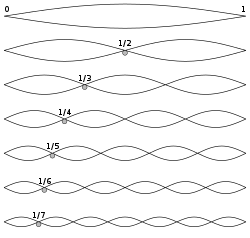
In the 6th century BC, the Greek philosopher Pythagoras wanted to know why some intervals seemed more beautiful than others, and he found answers in terms of numerical ratios representing the harmonic overtone series on a string. He is reputed to have observed that when the lengths of vibrating strings are expressible as ratios of integers (e.g. 2 to 3, 3 to 4), the tones produced will be harmonious. If, for example, a string sounds the note C when plucked, a string twice as long will sound the same note an octave lower. The tones in between are then given by 16:9 for D, 8:5 for E, 3:2 for F, 4:3 for G, 6:5 for A, and 16:15 for B, in ascending order.Aristotle (384-322 BC) understood that sound consisted of contractions and expansions of the air "falling upon and striking the air which is next to it...", a very good expression of the nature of wave motion. In about 20 BC, the Roman architect and engineer Vitruvius wrote a treatise on the acoustic properties of theatres including discussion of interference, echoes, and reverberation—the beginnings of architectural acoustics
Principles of acoustics were applied since ancient times : Roman theatre in the city of Amman.
The physical understanding of acoustical processes advanced rapidly during and after the Scientific Revolution. Mainly Galileo Galilei (1564–1642) but also Marin Mersenne (1588–1648), independently, discovered the complete laws of vibrating strings (completing what Pythagoras and Pytagoreans had started 2000 years earlier). Galileo wrote "Waves are produced by the vibrations of a sonorous body, which spread through the air, bringing to the tympanum of the ear a stimulus which the mind interprets as sound", a remarkable statement that points to the beginnings of physiological and psychological acoustics. Experimental measurements of the speed of sound in air were carried out successfully between 1630 and 1680 by a number of investigators, prominently Mersenne. Meanwhile Newton (1642–1727) derived the relationship for wave velocity in solids, a cornerstone of physical acoustics (Principia, 1687).
The Age of Enlightenment and onward
The eighteenth century saw major advances in acoustics as mathematicians applied the new techniques of calculus to elaborate theories of sound wave propagation. In the nineteenth century the major figures of mathematical acoustics were Helmholtz in Germany, who consolidated the field of physiological acoustics, and Lord Rayleigh in England, who combined the previous knowledge with his own copious contributions to the field in his monumental work "The Theory of Sound". Also in the 19th century, Wheatstone, Ohm, and Henry developed the analogy between electricity and acoustics.
The twentieth century saw a burgeoning of technological applications of the large body of scientific knowledge that was by then in place. The first such application was Sabine’s groundbreaking work in architectural acoustics, and many others followed. Underwater acoustics was used for detecting submarines in the first World War. Sound recording and the telephone played important roles in a global transformation of society. Sound measurement and analysis reached new levels of accuracy and sophistication through the use of electronics and computing. The ultrasonic frequency range enabled wholly new kinds of application in medicine and industry. New kinds of transducers (generators and receivers of acoustic energy) were invented and put to use.


Fundamental concepts of acoustics
Jay Pritzker Pavilion
At Jay Pritzker Pavilion, a LARES system is combined with a zoned sound reinforcement system, both suspended on an overhead steel trellis, to synthesize an indoor acoustic environment outdoors.
The study of acoustics revolves around the generation, propagation and reception of mechanical waves and vibrations.

The fundamental acoustical process
The steps shown in the above diagram can be found in any acoustical event or process. There are many kinds of cause, both natural and volitional. There are many kinds of transduction process that convert energy from some other form into acoustic energy, producing the acoustic wave. There is one fundamental equation that describes acoustic wave propagation, but the phenomena that emerge from it are varied and often complex. The wave carries energy throughout the propagating medium. Eventually this energy is transduced again into other forms, in ways that again may be natural and/or volitionally contrived. The final effect may be purely physical or it may reach far into the biological or volitional domains. The five basic steps are found equally well whether we are talking about an earthquake, a submarine using sonar to locate its foe, or a band playing in a rock concert.
The central stage in the acoustical process is wave propagation. This falls within the domain of physical acoustics. In fluids, sound propagates primarily as a pressure wave. In solids, mechanical waves can take many forms including longitudinal waves, transverse waves and surface waves.
Acoustics looks first at the pressure levels and frequencies in the sound wave. Transduction processes are also of special importance.
Wave propagation: pressure levels
Spectrogram of a young girl saying "oh, no"
In fluids such as air and water, sound waves propagate as disturbances in the ambient pressure level. While this disturbance is usually small, it is still noticeable to the human ear. The smallest sound that a person can hear, known as the threshold of hearing, is nine orders of magnitude smaller than the ambient pressure. The loudness of these disturbances is called the sound pressure level (SPL), and is measured on a logarithmic scale in decibels.
Wave propagation: frequency
Physicists and acoustic engineers tend to discuss sound pressure levels in terms of frequencies, partly because this is how our ears interpret sound. What we experience as "higher pitched" or "lower pitched" sounds are pressure vibrations having a higher or lower number of cycles per second. In a common technique of acoustic measurement, acoustic signals are sampled in time, and then presented in more meaningful forms such as octave bands or time frequency plots. Both these popular methods are used to analyze sound and better understand the acoustic phenomenon.
The entire spectrum can be divided into three sections: audio, ultrasonic, and infrasonic. The audio range falls between 20 Hz and 20,000 Hz. This range is important because its frequencies can be detected by the human ear. This range has a number of applications, including speech communication and music. The ultrasonic range refers to the very high frequencies: 20,000 Hz and higher. This range has shorter wavelengths which allows better resolution in imaging technologies. Medical applications such as ultrasonography and elastography rely on the ultrasonic frequency range. On the other end of the spectrum, the lowest frequencies are known as the infrasonic range. These frequencies can be used to study geological phenomena such as earthquakes.
Analytic instruments such as the Spectrum analyzer facilitate visualization and measurement of acoustic signals and their properties. The Spectrogram produced by such an instrument is a graphical display of the time varying pressure level and frequency profiles which give a specific acoustic signal its defining character.
Transduction in acoustics
An inexpensive low fidelity 3.5 inch driver, typically found in small radios
A transducer is a device for converting one form of energy into another. In an acoustical context, this usually means converting sound energy into electrical energy (or vice versa). For nearly all acoustic applications, some type of acoustic transducer is necessary. Acoustic transducers include loudspeakers, microphones, hydrophones and sonar projectors. These devices convert an electric signal to or from a sound pressure wave. The most widely used transduction principles are electromagnetism, electrostatics and piezoelectricity.
The transducers in most common loudspeakers (e.g. woofers and tweeters), are electromagnetic devices and generate waves using a suspended diaphragm driven by an electromagnetic voice coil, sending off pressure waves. Electret microphones and condenser microphones employ electrostatics. As the sound wave strikes the microphone's diaphragm, it moves and induces a voltage change. The ultrasonic systems used in medical ultrasonography employ piezoelectric transducers. These are made from special ceramics in which elastic vibrations and electrical fields are interlinked through a property of the material itself.
Divisions of acoustics
The table below shows seventeen major subfields of acoustics established in the PACS classification system. These have been grouped into three domains: physical acoustics, biological acoustics and acoustical engineering.
Physical acoustics Biological acoustics Acoustical engineering
* Aeroacoustics
* General linear acoustics
* Nonlinear acoustics
* Structural acoustics and vibration
* Underwater sound
* Bioacoustics
* Musical acoustics
* Physiological acoustics
* Psychoacoustics
* Speech communication (production;
perception; processing and communication systems)
* Acoustic measurements and instrumentation
* Acoustic signal processing
* Architectural acoustics
* Environmental acoustics
* Transduction
* Ultrasonics
* Room acoustics
Different fields of Science based on subjects
The Different Fields of Science
This is just a partial listing of some of the many, many different possible fields of study within science. Many of the fields listed here overlap to some degree with one or more other areas.
Natural Sciences
Biology
|
|
Chemistry
|
|

Physics
|
|
Earth Science
|
|
Descriptions of Fields of Science
Physics
Physics is the study of the natural world. It deals with the fundamental particles of which the universe is made, and the interactions between those particles, the objects composed of them (nuclei, atoms, molecules, etc) and energy.
Physics is the science of Nature - of matter and energy in space and time. Physicists study a wide range of physical phenomena covering enormous scales: from the subatomic particles to the Universe as a whole. All laws and forces of nature originate from mathematical symmetries of space and time, so modern physics currently focuses on studying these symmetries.
Physics is very dependent on mathematics. Models and theories in physics are expressed using mathematical equations. However, while physics uses mathematics to describe the material world, mathematics may deal with strictly abstract concepts and patterns. There is a large overlap between the two fields, known as mathematical physics.
Biology
Biology is the branch of science dealing with the study of life. It describes the characteristics, classification, and behaviors of organisms, how species come into existence, and the interactions they have with each other and with the environment. Biology has many specialized areas, covering a wide range of scales, from biochemistry to ecology.
Chemistry
Chemistry is the science of matter at or near the atomic scale. (Matter is the substance of which all physical objects are made.)
Chemistry deals with the properties of matter, and the transformation and interactions of matter and energy. Central to chemistry is the interaction of one substance with another, such as in a chemical reaction, where a substance or substances are transformed into another. Chemistry primarily studies atoms and collections of atoms such as molecules, crystals or metals that make up ordinary matter. According to modern chemistry it is the structure of matter at the atomic scale that determines the nature of a material.
Chemistry has many specialized areas that overlap with other sciences, such as physics, biology or geology. Scientists who study chemistry are called chemists. Historically, the science of chemistry is a recent development but has its roots in alchemy which has been practiced for millennia throughout the world. The word chemistry is directly derived from the word alchemy.
Earth Science
Earth science (also known as geoscience) deals with study of the planet Earth. It uses an interdisciplinary approach, including aspects of physics, geography, mathematics, chemistry, and biology. Some of the specialized areas include: geology (study of the rocky parts of the Earth's crust), oceanography and hydrology (marine and freshwater systems), and atmospheric sciences (weather and climate).
Subscribe to:
Posts (Atom)