In physics and chemistry, plasma is a substance similar to gas in which a certain portion of the particles are ionized. The presence of a non-negligible number of charge carriers makes the plasma electrically conductiveelectromagnetic fields. Plasma, therefore, has properties quite unlike those of solids, liquids, or gases and is considered to be a distinct state of matter. Like gas, plasma does not have a definite shape or a definite volume unless enclosed in a container; unlike gas, in the influence of a magnetic field, it may form structures such as filaments, beams and double layers. Some common plasmas are stars and neon signs. so that it responds strongly to
Plasma was first identified in a Crookes tube, and so described by Sir William Crookes in 1879 (he called it "radiant matter") The nature of the Crookes tube "cathode ray" matter was subsequently identified by British physicist Sir J.J. Thomson in 1897, and dubbed "plasma" by Irving Langmuir in 1928, perhaps because it reminded him of a blood plasma. Langmuir wrote:
Except near the electrodes, where there are sheaths containing very few electrons, the ionized gas contains ions and electrons in about equal numbers so that the resultant space charge is very small. We shall use the name plasma to describe this region containing balanced charges of ions and electrons.
Plasma properties and parameters
Artist's rendition of the Earth's "plasma fountain", showing oxygen, helium, and hydrogen ions which gush into space from regions near the Earth's poles. The faint yellow area shown above the north pole represents gas lost from Earth into space; the green area is the aurora borealis, where plasma energy pours back into the atmosphere.
Definition of a plasma
Although a plasma is loosely described as an electrically neutral medium of positive and negative particles, a definition can have three criteria:
- The plasma approximation: Charged particles must be close enough together that each particle influences many nearby charged particles, rather than just interacting with the closest particle (these collective effects are a distinguishing feature of a plasma). The plasma approximation is valid when the number of charge carriers within the sphere of influence (called the Debye sphere whose radius is the Debye screening length) of a particular particle are higher than unity to provide collective behavior of the charged particles. The average number of particles in the Debye sphere is given by the plasma parameter, "Λ" (the Greek letter Lambda).
- Bulk interactions: The Debye screening length (defined above) is short compared to the physical size of the plasma. This criterion means that interactions in the bulk of the plasma are more important than those at its edges, where boundary effects may take place. When this criterion is satisfied, the plasma is quasineutral.
- Plasma frequency: The electron plasma frequency (measuring plasma oscillations of the electrons) is large compared to the electron-neutral collision frequency (measuring frequency of collisions between electrons and neutral particles). When this condition is valid, electrostatic interactions dominate over the processes of ordinary gas kinetics.
Ranges of plasma parameters
Plasma parameters can take on values varying by many orders of magnitude, but the properties of plasmas with apparently disparate parameters may be very similar (see plasma scaling). The following chart considers only conventional atomic plasmas and not exotic phenomena like quark gluon plasmas:
| Typical ranges of plasma parameters: orders of magnitude | ||
|---|---|---|
| Characteristic | Terrestrial plasmas | Cosmic plasmas |
| Size in meters | 10−6 m (lab plasmas) to 102 m (lightning) (~8 OOM) | 10−6 m (spacecraft sheath) to 1025 m (intergalactic nebula) (~31 OOM) |
| Lifetime in seconds | 10−12 s (laser-produced plasma) to 107 s (fluorescent lights) (~19 OOM) | 101 s (solar flares) to 1017 s (intergalactic plasma) (~16 OOM) |
| Density in particles per cubic meter | 107 m−3 to 1032 m−3 (inertial confinement plasma) | 1 m−3 (intergalactic medium) to 1030 m−3 (stellar core) |
| Temperature in kelvins | ~0 K (crystalline non-neutral plasma[10]) to 108 K (magnetic fusion plasma) | 102 K (aurora) to 107 K (solar core) |
| Magnetic fields in teslas | 10−4 T (lab plasma) to 103 T (pulsed-power plasma) | 10−12 T (intergalactic medium) to 1011 T (near neutron stars) |
Degree of ionization
For plasma to exist, ionization is necessary. The term "plasma density" by itself usually refers to the "electron density", that is, the number of free electrons per unit volume. The degree of ionization of a plasma is the proportion of atoms which have lost (or gained) electrons, and is controlled mostly by the temperature. Even a partially ionized gas in which as little as 1% of the particles are ionized can have the characteristics of a plasma (i.e., response to magnetic fields and high electrical conductivity). The degree of ionization, α is defined as α = ni/(ni + na) where ni is the number density of ions and na is the number density of neutral atoms. The electron density is related to this by the average charge state <Z> of the ions through ne = <Z> ni where ne is the number density of electrons.
Temperatures
Plasma temperature is commonly measured in kelvins or electronvolts and is an informal measure of the thermal kinetic energy per particle. In most cases the electrons are close enough to thermal equilibrium that their temperature is relatively well-defined, even when there is a significant deviation from a Maxwellian energy distribution function, for example, due to UV radiation, energetic particles, or strong electric fields. Because of the large difference in mass, the electrons come to thermodynamic equilibrium amongst themselves much faster than they come into equilibrium with the ions or neutral atoms. For this reason, the "ion temperature" may be very different from (usually lower than) the "electron temperature". This is especially common in weakly ionized technological plasmas, where the ions are often near the ambient temperature.
Based on the relative temperatures of the electrons, ions and neutrals, plasmas are classified as "thermal" or "non-thermal". Thermal plasmas have electrons and the heavy particles at the same temperature, i.e., they are in thermal equilibrium with each other. Non-thermal plasmas on the other hand have the ions and neutrals at a much lower temperature, (normally room temperature), whereas electrons are much "hotter".
Temperature controls the degree of plasma ionization. In particular, plasma ionization is determined by the "electron temperature" relative to the ionization energy, (and more weakly by the density), in a relationship called the Saha equation. A plasma is sometimes referred to as being "hot" if it is nearly fully ionized, or "cold" if only a small fraction, (for example 1%), of the gas molecules are ionized, but other definitions of the terms "hot plasma" and "cold plasma" are common. Even in a "cold" plasma, the electron temperature is still typically several thousand degrees Celsius. Plasmas utilized in "plasma technology" ("technological plasmas") are usually cold in this sense.
Potentials
Lightning is an example of plasma present at Earth's surface. Typically, lightning discharges 30,000 amperes at up to 100 million volts, and emits light, radio waves, X-rays and even gamma rays. Plasma temperatures in lightning can approach ~28,000 kelvin and electron densities may exceed 1024 m−3.
Since plasmas are very good conductors, electric potentials play an important role. The potential as it exists on average in the space between charged particles, independent of the question of how it can be measured, is called the "plasma potential", or the "space potential". If an electrode is inserted into a plasma, its potential will generally lie considerably below the plasma potential due to what is termed a Debye sheath. The good electrical conductivity of plasmas causes their electric fields to be very small. This results in the important concept of "quasineutrality", which says the density of negative charges is approximately equal to the density of positive charges over large volumes of the plasma (ne = <Z>ni), but on the scale of the Debye length there can be charge imbalance. In the special case that double layers are formed, the charge separation can extend some tens of Debye lengths.
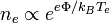
The magnitude of the potentials and electric fields must be determined by means other than simply finding the net charge density. A common example is to assume that the electrons satisfy the "Boltzmann relation":
 .
.
Differentiating this relation provides a means to calculate the electric field from the density:
 .
.
It is possible to produce a plasma which is not quasineutral. An electron beam, for example, has only negative charges. The density of a non-neutral plasma must generally be very low, or it must be very small, otherwise it will be dissipated by the repulsive electrostatic force.
In astrophysical plasmas, Debye screening prevents electric fields from directly affecting the plasma over large distances, i.e., greater than the Debye length. But the existence of charged particles causes the plasma to generate and can be affected by magnetic fields. This can and does cause extremely complex behavior, such as the generation of plasma double layers, an object which separates charge over a few tens of Debye lengths. The dynamics of plasmas interacting with external and self-generated magnetic fields are studied in the academic discipline of magnetohydrodynamics.
Magnetization
Plasma in which the magnetic field is strong enough to influence the motion of the charged particles is said to be magnetized. A common quantitative criterion is that a particle on average completes at least one gyration around the magnetic field before making a collision, i.e., ωce/νcoll > 1, where ωce is the "electron gyrofrequency" and νcoll is the "electron collision rate". It is often the case that the electrons are magnetized while the ions are not. Magnetized plasmas are anisotropic, meaning that their properties in the direction parallel to the magnetic field are different from those perpendicular to it. While electric fields in plasmas are usually small due to the high conductivity, the electric field associated with a plasma moving in a magnetic field is given by E = −v x B (where E is the electric field, v is the velocity, and B is the magnetic field), and is not affected by Debye shielding.
Comparison of plasma and gas phases
Plasma is often called the fourth state of matter. It is distinct from other lower-energy states of matter; most commonly solid, liquid, and gas. Although it is closely related to the gas phase in that it also has no definite form or volume, it differs in a number of ways, including the following:
| Property | Gas | Plasma |
| Electrical Conductivity | Very low | Usually very high
|
| Independently acting species | One
| Two or three |
| Velocity distribution | Maxwellian
| Often non-Maxwellian
|
| Interactions | Binary
| Collective
|
Complex plasma phenomena
The remnant of "Tycho's Supernova", a huge ball of expanding plasma. The outer shell shown in blue is X-ray emission by high-speed electrons.
Although the underlying equations governing plasmas are relatively simple, plasma behavior is extraordinarily varied and subtle: the emergence of unexpected behavior from a simple model is a typical feature of a complex system. Such systems lie in some sense on the boundary between ordered and disordered behavior and cannot typically be described either by simple, smooth, mathematical functions, or by pure randomness. The spontaneous formation of interesting spatial features on a wide range of length scales is one manifestation of plasma complexity. The features are interesting, for example, because they are very sharp, spatially intermittent (the distance between features is much larger than the features themselves), or have a fractal form. Many of these features were first studied in the laboratory, and have subsequently been recognized throughout the universe. Examples of complexity and complex structures in plasmas include:
Filamentation
Striations or string-like structures are seen in many plasmas, like the plasma ball (image above), the aurora,lightning,electric arcs, solar flares,and supernova remnants. They are sometimes associated with larger current densities, and the interaction with the magnetic field can form a magnetic rope structure. High power microwave breakdown at atmospheric pressure also leads to the formation of filamentary structures (See also Plasma pinch)
Filamentation also refers to the self-focusing of a high power laser pulse. At high powers, the nonlinear part of the index of refraction becomes important and causes a higher index of refraction in the center of the laser beam, where the laser is brighter than at the edges, causing a feedback that focuses the laser even more. The tighter focused laser has a higher peak brightness (irradiance) that forms a plasma. The plasma has an index of refraction lower than one, and causes a defocusing of the laser beam. The interplay of the focusing index of refraction, and the defocusing plasma makes the formation of a long filament of plasma that can be micrometers to kilometers in length.
Shocks or double layers
Plasma properties change rapidly (within a few Debye lengths) across a two-dimensional sheet in the presence of a (moving) shock or (stationary) double layer. Double layers involve localized charge separation, which causes a large potential difference across the layer, but does not generate an electric field outside the layer. Double layers separate adjacent plasma regions with different physical characteristics, and are often found in current carrying plasmas. They accelerate both ions and electrons.
Electric fields and circuits
Quasineutrality of a plasma requires that plasma currents close on themselves in electric circuits. Such circuits follow Kirchhoff's circuit laws and possess a resistance and inductance. These circuits must generally be treated as a strongly coupled system, with the behavior in each plasma region dependent on the entire circuit. It is this strong coupling between system elements, together with nonlinearity, which may lead to complex behavior. Electrical circuits in plasmas store inductive (magnetic) energy, and should the circuit be disrupted, for example, by a plasma instability, the inductive energy will be released as plasma heating and acceleration. This is a common explanation for the heating which takes place in the solar corona. Electric currents, and in particular, magnetic-field-aligned electric currents (which are sometimes generically referred to as "Birkeland currents"), are also observed in the Earth's aurora, and in plasma filaments.
Cellular structure
Narrow sheets with sharp gradients may separate regions with different properties such as magnetization, density and temperature, resulting in cell-like regions. Examples include the magnetosphere, heliosphere, and heliospheric current sheet. Hannes Alfvén wrote: "From the cosmological point of view, the most important new space research discovery is probably the cellular structure of space. As has been seen in every region of space which is accessible to in situ measurements, there are a number of 'cell walls', sheets of electric currents, which divide space into compartments with different magnetization, temperature, density, etc."[22]
Critical ionization velocity
The critical ionization velocity is the relative velocity between an ionized plasma and a neutral gas above which a runaway ionization process takes place. The critical ionization process is a quite general mechanism for the conversion of the kinetic energy of a rapidly streaming gas into ionization and plasma thermal energy. Critical phenomena in general are typical of complex systems, and may lead to sharp spatial or temporal features.
Ultracold plasma
Ultracold plasmas are created in a magneto-optical trap (MOT) by trapping and cooling neutral atoms, to temperatures of 1 mK or lower, and then using another laser to ionize the atoms by giving each of the outermost electrons just enough energy to escape the electrical attraction of its parent ion.
One advantage of ultracold plasmas is their well characterized and tunable initial conditions, including size and electron temperature. By adjusting the wavelength of the ionizing laser, the kinetic energy of the liberated electrons can be tuned as low as 0.1 K, a limit set by the frequency bandwidth of the laser pulse. The ions, inherit the millikelvin temperatures of the neutral atoms, but are quickly heated through a process known as disorder induced heating (DIH). This type of non-equilibrium ultracold plasma evolves rapidly, and displays many other interesting phenomena.
One of the metastable states of a strongly nonideal plasma is Rydberg matter, which forms upon condensation of excited atoms.
Non-neutral plasma
The strength and range of the electric force and the good conductivity of plasmas usually ensure that the densities of positive and negative charges in any sizeable region are equal ("quasineutrality"). A plasma which has a significant excess of charge density, or, which is, in the extreme case, composed of only a single species, is called a non-neutral plasma. In such a plasma, electric fields play a dominant role. Examples are charged particle beams, an electron cloud in a Penning trap and positron plasmas.
Dusty plasma and grain plasma
A dusty plasma is one containing tiny charged particles of dust (typically found in space) which also behaves like a plasma. A plasma containing larger particles is called grain plasma.
Mathematical descriptions
The complex self-constricting magnetic field lines and current paths in a field-aligned Birkeland current which may develop in a plasma.
Main article: Plasma modeling
To completely describe the state of a plasma, we would need to write down all the particle locations and velocities and describe the electromagnetic field in the plasma region. However, it is generally not practical or necessary to keep track of all the particles in a plasma. Therefore, plasma physicists commonly use less detailed descriptions, of which there are two main types:
Fluid model
Fluid models describe plasmas in terms of smoothed quantities, like density and averaged velocity around each position (see Plasma parameters). One simple fluid model, magnetohydrodynamics, treats the plasma as a single fluid governed by a combination of Maxwell's equations and the Navier–Stokes equations. A more general description is the two-fluid plasma picture, where the ions and electrons are described separately. Fluid models are often accurate when collisionality is sufficiently high to keep the plasma velocity distribution close to a Maxwell–Boltzmann distribution. Because fluid models usually describe the plasma in terms of a single flow at a certain temperature at each spatial location, they can neither capture velocity space structures like beams or double layers, nor resolve wave-particle effects.
Kinetic model
Kinetic models describe the particle velocity distribution function at each point in the plasma and therefore do not need to assume a Maxwell–Boltzmann distribution. A kinetic description is often necessary for collisionless plasmas. There are two common approaches to kinetic description of a plasma. One is based on representing the smoothed distribution function on a grid in velocity and position. The other, known as the particle-in-cell (PIC) technique, includes kinetic information by following the trajectories of a large number of individual particles. Kinetic models are generally more computationally intensive than fluid models. The Vlasov equation may be used to describe the dynamics of a system of charged particles interacting with an electromagnetic field. In magnetized plasmas, a gyrokinetic approach can substantially reduce the computational expense of a fully kinetic simulation.
Common artificial plasma
Most artificial plasmas are generated by the application of electric and/or magnetic fields. Plasma generated in a laboratory setting and for industrial use can be generally categorized by:
- The type of power source used to generate the plasma; DC, RF and microwave.
- The pressure at which they operate; vacuum pressure (< 10 mTorr or 1 Pa), moderate pressure (~ 1 Torr or 100 Pa), atmospheric pressure (760 Torr or 100 kPa).
- The degree of ionization within the plasma; fully ionized, partially ionized, weakly ionized.
- The temperature relationships within the plasma: thermal plasma (Te = Tion = Tgas), non-thermal or "cold" plasma (Te >> Tion = Tgas)
- The electrode configuration used to generate the plasma.
- The magnetization of the particles within the plasma; Magnetized (both ion and electrons are trapped in Larmor orbits by the magnetic field), partially magnetized (the electrons but not the ions are trapped by the magnetic field), non-magnetized (the magnetic field is too weak to trap the particles in orbits but may generate Lorentz forces).
- Its application
Examples of industrial/commercial plasma
Low-pressure discharges
- Glow discharge plasmas: non-thermal plasmas generated by the application of DC or low frequency RF (<100 kHz) electric field to the gap between two metal electrodes. Probably the most common plasma; this is the type of plasma generated within fluorescent light tubes.
- Capacitively coupled plasma (CCP): similar to glow discharge plasmas, but generated with high frequency RF electric fields, typically 13.56 MHz. These differ from glow discharges in that the sheaths are much less intense. These are widely used in the microfabrication and integrated circuit manufacturing industries for plasma etching and plasma enhanced chemical vapor deposition.
- Inductively coupled plasma (ICP): similar to a CCP and with similar applications but the electrode consists of a coil wrapped around the discharge volume which inductively excites the plasma.
- Wave heated plasma: similar to CCP and ICP in that it is typically RF (or microwave), but is heated by both electrostatic and electromagnetic means. Examples are helicon discharge, electron cyclotron resonance (ECR), and ion cyclotron resonance (ICR). These typically require a coaxial magnetic field for wave propagation.
Atmospheric pressure
- Arc discharge: this is a high power thermal discharge of very high temperature (~10,000 K). It can be generated using various power supplies. It is commonly used in metallurgical processes. For example, it is used to melt rocks containing Al2O3 to produce aluminium.
- Corona discharge: this is a non-thermal discharge generated by the application of high voltage to sharp electrode tips. It is commonly used in ozone generators and particle precipitators.
- Dielectric barrier discharge (DBD): this is a non-thermal discharge generated by the application of high voltages across small gaps wherein a non-conducting coating prevents the transition of the plasma discharge into an arc. It is often mislabeled 'Corona' discharge in industry and has similar application to corona discharges. It is also widely used in the web treatment of fabrics. The application of the discharge to synthetic fabrics and plastics functionalizes the surface and allows for paints, glues and similar materials to adhere.
- Capacitive discharge: this is a nonthermal plasma generated by the application of RF power (e.g., 13.56 MHz) to one powered electrode, with a grounded electrode held at a small separation distance on the order of 1 cm. Such discharges are commonly stabilized using a noble gas such as helium or argon
Fields of active research
Hall effect thruster. The electric field in a plasma double layer is so effective at accelerating ions that electric fields are used in ion drives.
This is just a partial list of topics. A more complete and organized list can be found on the web site for Plasma science and technology.
|
|


