Seeker

Loading

Wednesday, December 22, 2010

Theory of relativity

The theory of relativity, or simply relativity, encompasses two theories of Albert Einstein: special relativity and general relativity. However, the word "relativity" is sometimes used in reference to Galilean invariance.
The term "theory of relativity" was based on the expression "relative theory" (German: Relativtheorie) used by Max Planck in 1906, who emphasized how the theory uses the principle of relativity. In the discussion section of the same paper Alfred Bucherer used for the first time the expression "theory of relativity" (German: Relativitätstheorie).


Scope

The theory of relativity enriched physics and astronomy during the 20th century. When first published, relativity superseded a 200-year-old theory of mechanics elucidated by Isaac Newton. It changed perceptions.

For example, it overturned the concept of motion from Newton's day, into all motion is relative. Time was no longer uniform and absolute, as related to everyday experience. Furthermore, no longer could physics be understood as space by itself, and time by itself. Instead, an added dimension had to be taken into account with curved space-time. Time now depended on velocity, and contraction became a fundamental consequence at appropriate speeds.

In the field of microscopic physics, relativity catalyzed and added an essential depth of knowledge to the science of elementary particles and their fundamental interactions, along with introducing the nuclear age. With relativity, cosmology and astrophysics predicted extraordinary astronomical phenomena such as neutron stars, black holes, and gravitational waves.
Two theory view

The theory of relativity was representative of more than a single new physical theory. It affected the theories and methodologies across all the physical sciences. However, as stated above, this is more likely perceived as two separate theories. There are some related explanations for this. First, special relativity was published in 1905, and the final form of general relativity was published in 1916.

Second, special relativity fits with and solves for elementary particles and their interactions, whereas general relativity solves for the cosmological and astrophysical realm (including astronomy).

Third, special relativity was widely accepted in the physics community by 1920. This theory rapidly became a notable and necessary tool for theorists and experimentalists in the new fields of atomic physics, nuclear physics, and quantum mechanics. Conversely, general relativity did not appear to be as useful. There had appeared to be little applicability for experimentalists as most applications were for astronomical scales. It seemed limited to only making minor corrections to predictions of Newtonian gravitation theory. Its impact was not apparent until the 1930s.

Finally, the mathematics of general relativity appeared to be incomprehensibly dense. Consequently, only a small number of people in the world, at that time, could fully understand the theory in detail. This remained the case for the next 40 years. Then, at around 1960 a critical resurgence in interest occurred which has resulted in making general relativity central to physics and astronomy. New mathematical techniques applicable to the study of general relativity substantially streamlined calculations. From this, physically discernible concepts were isolated from the mathematical complexity. Also, the discovery of exotic astronomical phenomena in which general relativity was crucially relevant, helped to catalyze this resurgence. The astronomical phenomena included quasars (1963), the 3-kelvin microwave background radiation (1965), pulsars (1967), and the discovery of the first black hole candidates

Monday, December 13, 2010

HTML

HTML, which stands for HyperText Markup Language, is the predominant markup language for web pages. A markup language is a set of markup tags, and HTML uses markup tags to describe web pages.

HTML is written in the form of HTML elements consisting of "tags" surrounded by angle brackets (like <html>) within the web page content. HTML tags normally come in pairs like <b> and </b>. The first tag in a pair is the start tag, the second tag is the end tag (they are also called opening tags and closing tags).

The purpose of a web browser is to read HTML documents and display them as web pages. The browser does not display the HTML tags, but uses the tags to interpret the content of the page.

HTML elements form the building blocks of all websites. HTML allows images and objects to be embedded and can be used to create interactive forms. It provides a means to create structured documents by denoting structural semantics for text such as headings, paragraphs, lists, links, quotes and other items. It can embed scripts in languages such as JavaScript which affect the behavior of HTML webpages.
HTML can also be used to include Cascading Style Sheets (CSS) to define the appearance and layout of text and other material. The W3C, maintainer of both HTML and CSS standards, encourages the use of CSS over explicit presentational markup

Tuesday, November 30, 2010

Website

A website (also spelled Web site) is a collection of related web pages, images, videos or other digital assets that are addressed relative to a common Uniform Resource Locator (URL), often consisting of only the domain name, or the IP address, and the root path ('/') in an Internet Protocol-based network. A web site is hosted on at least one web server, accessible via a network such as the Internet or a private local area network.

A web page is a document, typically written in plain text interspersed with formatting instructions of Hypertext Markup Language (HTML, XHTML). A web page may incorporate elements from other websites with suitable markup anchors.

Web pages are accessed and transported with the Hypertext Transfer Protocol (HTTP), which may optionally employ encryption (HTTP Secure, HTTPS) to provide security and privacy for the user of the web page content. The user's application, often a web browser, renders the page content according to its HTML markup instructions onto a display terminal.

All publicly accessible websites collectively constitute the World Wide Web.

The pages of a website can usually be accessed from a simple Uniform Resource Locator (URL) called the homepage. The URLs of the pages organize them into a hierarchy, although hyperlinking between them conveys the reader's perceived site structure and guides the reader's navigation of the site.

Some websites require a subscription to access some or all of their content. Examples of subscription websites include many business sites, parts of news websites, academic journal websites, gaming websites, message boards, web-based e-mail, social networking websites, websites providing real-time stock market data, and websites providing various other services (e.g. websites offering storing and/or sharing of images, files and so forth).


History

The World Wide Web (WWW) was created in 1989 by CERN physicist Tim Berners-Lee.[3] On 30 April 1993, CERN announced that the World Wide Web would be free to use for anyone.[4] Before the introduction of HTML and HTTP, other protocols such as file transfer protocol and the gopher protocol were used to retrieve individual files from a server. These protocols offer a simple directory structure which the user navigates and chooses files to download. Documents were most often presented as plain text files without formatting or were encoded in word processor formats.
Overview

Organized by function, a website may be

    * a personal website
    * a commercial website
    * a government website
    * a non-profit organization website

It could be the work of an individual, a business or other organization, and is typically dedicated to some particular topic or purpose. Any website can contain a hyperlink to any other website, so the distinction between individual sites, as perceived by the user, may sometimes be blurred.

Websites are written in, or dynamically converted to, HTML (Hyper Text Markup Language) and are accessed using a software interface classified as a user agent. Web pages can be viewed or otherwise accessed from a range of computer-based and Internet-enabled devices of various sizes, including desktop computers, laptops, PDAs and cell phones.

A website is hosted on a computer system known as a web server, also called an HTTP server, and these terms can also refer to the software that runs on these systems and that retrieves and delivers the web pages in response to requests from the website users. Apache is the most commonly used web server software (according to Netcraft statistics) and Microsoft's Internet Information Server (IIS) is also commonly used.
Static website

A static website is one that has web pages stored on the server in the format that is sent to a client web browser. It is primarily coded in Hypertext Markup Language (HTML).

Simple forms or marketing examples of websites, such as classic website, a five-page website or a brochure website are often static websites, because they present pre-defined, static information to the user. This may include information about a company and its products and services via text, photos, animations, audio/video and interactive menus and navigation.

This type of website usually displays the same information to all visitors. Similar to handing out a printed brochure to customers or clients, a static website will generally provide consistent, standard information for an extended period of time. Although the website owner may make updates periodically, it is a manual process to edit the text, photos and other content and may require basic website design skills and software.

In summary, visitors are not able to control what information they receive via a static website, and must instead settle for whatever content the website owner has decided to offer at that time.

They are edited using four broad categories of software:

    * Text editors, such as Notepad or TextEdit, where content and HTML markup are manipulated directly within the editor program
    * WYSIWYG offline editors, such as Microsoft FrontPage and Adobe Dreamweaver (previously Macromedia Dreamweaver), with which the site is edited using a GUI interface and the final HTML markup is generated automatically by the editor software
    * WYSIWYG online editors which create media rich online presentation like web pages, widgets, intro, blogs, and other documents.
    * Template-based editors, such as Rapidweaver and iWeb, which allow users to quickly create and upload web pages to a web server without detailed HTML knowledge, as they pick a suitable template from a palette and add pictures and text to it in a desktop publishing fashion without direct manipulation of HTML code.

Dynamic website

A dynamic website is one that changes or customizes itself frequently and automatically, based on certain criteria.

Dynamic websites can have two types of dynamic activity: Code and Content. Dynamic code is invisible or behind the scenes and dynamic content is visible or fully displayed.
Dynamic code

The first type is a web page with dynamic code. The code is constructed dynamically on the fly using active programming language instead of plain, static HTML.

A website with dynamic code refers to its construction or how it is built, and more specifically refers to the code used to create a single web page. A dynamic web page is generated on the fly by piecing together certain blocks of code, procedures or routines. A dynamically-generated web page would call various bits of information from a database and put them together in a pre-defined format to present the reader with a coherent page. It interacts with users in a variety of ways including by reading cookies recognizing users' previous history, session variables, server side variables etc., or by using direct interaction (form elements, mouse overs, etc.). A site can display the current state of a dialogue between users, monitor a changing situation, or provide information in some way personalized to the requirements of the individual user.
Dynamic content

The second type is a website with dynamic content displayed in plain view. Variable content is displayed dynamically on the fly based on certain criteria, usually by retrieving content stored in a database.

A website with dynamic content refers to how its messages, text, images and other information are displayed on the web page, and more specifically how its content changes at any given moment. The web page content varies based on certain criteria, either pre-defined rules or variable user input. For example, a website with a database of news articles can use a pre-defined rule which tells it to display all news articles for today's date. This type of dynamic website will automatically show the most current news articles on any given date. Another example of dynamic content is when a retail website with a database of media products allows a user to input a search request for the keyword Beatles. In response, the content of the web page will spontaneously change the way it looked before, and will then display a list of Beatles products like CD's, DVD's and books.
Purpose of dynamic websites

The main purpose of a dynamic website is automation. A dynamic website can operate more effectively, be built more efficiently and is easier to maintain, update and expand. It is much simpler to build a template and a database than to build hundreds or thousands of individual, static HTML web pages.
Software systems

There is a wide range of software systems, such as ANSI C servlets), Java Server Pages (JSP), the PHP and Perl programming languages, ASP.NET, Active Server Pages (ASP), YUMA and ColdFusion (CFML) that are available to generate dynamic web systems and dynamic sites. Sites may also include content that is retrieved from one or more databases or by using XML-based technologies such as RSS.

Static content may also be dynamically generated either periodically, or if certain conditions for regeneration occur (cached) in order to avoid the performance loss of initiating the dynamic engine on a per-user or per-connection basis.

Plug ins are available to expand the features and abilities of web browsers, which use them to show active content, such as Microsoft Silverlight, Adobe Flash, Adobe Shockwave or applets written in Java. Dynamic HTML also provides for user interactivity and realtime element updating within web pages (i.e., pages don't have to be loaded or reloaded to effect any changes), mainly using the Document Object Model (DOM) and JavaScript, support which is built-in to most modern web browsers.

Turning a website into an income source is a common practice for web developers and website owners. There are several methods for creating a website business which fall into two broad categories, as defined below.
 Content-based sites

Some websites derive revenue by selling advertising space on the site (see Contextual advertising).
 Product- or service-based sites

Some websites derive revenue by offering products or services for sale. In the case of e-commerce websites, the products or services may be purchased at the website itself, by entering credit card or other payment information into a payment form on the site. While most business websites serve as a shop window for existing brick and mortar businesses, it is increasingly the case that some websites are businesses in their own right; that is, the products they offer are only available for purchase on the web.

Websites occasionally derive income from a combination of these two practices. For example, a website such as an online auctions website may charge the users of its auction service to list an auction, but also display third-party advertisements on the site, from which it derives further income.
Spelling

The form "website" has become the standard spelling, but previously "Web site" (capitalised) and "web site" were also widely used. Some academia, some large book publishers, and some dictionaries still use "Web site", reflecting the origin of the term in the proper name World Wide Web. There has also been similar debate regarding related terms such as web page, webmaster, and webcam.

Among leading style guides, the Reuters style guide , the Chicago Manual of Style , and the AP Stylebook (since April 2010)  all recommend "website".

Among leading dictionaries and encyclopaedias, the Canadian Oxford Dictionary prefers "website", and the Oxford English Dictionary changed to "website" in 2004.. Wikipedia also uses "website", but Encyclopædia Britannica  (including its Merriam-Webster subsidiary ) uses "Web site".

Among leading language-usage commentators, Garner's Modern American Usage acknowledges that "website" is the standard form , but Bill Walsh, of the Washington Post, argues for using "Web site" in his books and on his website  (however, the Washington Post itself uses "website" ).

Among major internet technology companies, Microsoft uses "website" and occasionally "web site" , Apple uses "website" , and Google uses "website".

Monday, November 29, 2010

Web design

Web design is a broad term used to encompass the way that content (usually hypertext or hypermedia) that are delivered to an end-user through the World Wide Web, using a web browser or other web-enabled software is displayed. The intent of web design is to create a website—a collection of online content including documents and applications that reside on a web server/servers. The website may include text, images, sounds and other content, and may be interactive.

Overview

Web design involves the structure of the website including the information architecture (navigation schemes and naming conventions), the layout or the pages (wireframes or page schematics are created to show consistent placement of items including functional features), and the conceptual design with branding.
All websites should begin with a clear strategy so that it is apparent what they are trying to achieve. The strategy then enables the design to fulfill defined goals.

Content

Such elements as text, forms, images (GIFs, JPEGs, Portable Network Graphics) and video can be placed on the page using HTML/XHTML/XML tags. Older browsers may require Plug-ins such as Adobe Flash, QuickTime, Java run-time environment, etc. to display some media, which are embedded into web page by using HTML/XHTML tags.

Improvements in browsers' compliance with W3C standards prompted a widespread acceptance and usage of XHTML/XML in conjunction with Cascading Style Sheets (CSS) to position and manipulate web page elements and objects.

Typically web pages are classified as static or dynamic:

    * Static pages don’t change content and layout with every request unless a human (web master/programmer) manually updates the page. A simple HTML page is an example of static content.
    * Dynamic pages adapt their content and/or appearance depending on end-user’s input/interaction or changes in the computing environment (user, time, database modifications, etc.) Content can be changed on the client side (end-user's computer) by using client-side scripting languages (JavaScript, JScript, Actionscript, etc.) to alter DOM elements (DHTML). Dynamic content is often compiled on the server utilizing server-side scripting languages (Perl, PHP, ASP, JSP, ColdFusion, etc.). Both approaches are usually used in complex applications.

With growing specialization in the information technology field there is a strong tendency to distinguish between web design and web development.   Web design is a kind of graphic design intended for the development and styling of objects of the Internet's information environment to provide them with high-end consumer features and aesthetic qualities.


This definition separates web design from web programming, emphasizing the functional features of a web site, as well as positioning web design as a kind of graphic design. The process of designing web pages, web sites, web applications or multimedia for the Web may utilize multiple disciplines, such as animation, authoring, communication design, corporate identity, graphic design, human-computer interaction, information architecture, interaction design, marketing, photography, search engine optimization and typography.

    * Markup languages (such as HTML, XHTML and XML)
    * Style sheet languages (such as CSS and XSL)
    * Client-side scripting (such as JavaScript)
    * Server-side scripting (such as PHP and ASP)
    * Database technologies (such as MySQL and PostgreSQL)
    * Multimedia technologies (such as Flash and Silverlight)

Web pages and websites can be static pages, or can be programmed to be dynamic pages that automatically adapt content or visual appearance depending on a variety of factors, such as input from the end-user, input from the webmaster or changes in the computing environment (such as the site's associated database having been modified).

Accessible web design

To be accessible, web pages and sites must conform to certain accessibility principles. These accessibility principles are known as the WCAG when talking about content. These can be grouped into the following main areas.

    * Use semantic markup that provides a meaningful structure to the document (i.e. web page)
    * Semantic markup also refers to semantically organizing the web page structure and publishing web services description accordingly so that they can be recognized by other web services on different web pages. Standards for semantic web are set by IEEE
    * Use a valid markup language that conforms to a published DTD or Schema
    * Provide text equivalents for any non-text components (e.g. images, multimedia)
    * Use hyperlinks that make sense when read out of context. (e.g. avoid "Click Here")


Website accessibility is also changing as it is impacted by Content Management Systems that allow changes to be made to webpages without the need of obtaining web-based programming language knowledge.

It is very important that several different components of web development and interaction can work together in order for the Web to be accessible to people with disabilities. These components include:

    * content - the information in a web page or web application, including:
          o natural information such as text, images, and sounds
          o code or markup that defines structure, presentation, etc.
    * Web browsers, media players, and other "user agents"
    * assistive technology, in some cases - screen readers, alternative keyboards, switches, scanning software, etc.
    * users' knowledge, experiences, and in some cases, adaptive strategies using the Web
    * developers - designers, coders, authors, etc., including developers with disabilities and users who contribute content
    * authoring tools - software that creates web sites
    * evaluation tools - web accessibility evaluation tools, HTML validators, CSS validators, etc.

History

Tim Berners-Lee published what is considered to be the first website in August 1991. Berners-Lee was the first to combine Internet communication (which had been carrying email and the Usenet for decades) with hypertext (which had also been around for decades, but limited to browsing information stored on a single computer, such as interactive CD-ROM design). Websites are written in a markup language called HTML, and early versions of HTML were very basic, only giving a website's basic structure (headings and paragraphs), and the ability to link using hypertext. This was new and different from existing forms of communication - users could easily navigate to other pages by following hyperlinks from page to page.

As the Web and web design progressed, the markup language changed to become more complex and flexible, giving the ability to add objects like images and tables to a page. Features like tables, which were originally intended to be used to display tabular information, were soon subverted for use as invisible layout devices. With the advent of Cascading Style Sheets (CSS), table-based layout is commonly regarded as outdated. Database integration technologies such as server-side scripting and design standards like W3C further changed and enhanced the way the Web is made. As times change, websites are changing the code on the inside and visual design on the outside with ever-evolving programs and utilities.

With the progression of the Web, tens of thousands of web design companies have been established around the world to serve the growing demand for such work. As with much of the information technology industry, many web design companies have been established in technology parks in the developing world as well as many Western design companies setting up offices in countries such as India, Romania, and Russia to take advantage of the relatively lower labor rates found in such countries.

Website planning

Purposing web design is a complex, but essential ongoing activity. Before creating and uploading a website, it is important to take the time to plan exactly what is needed in the website. Thoroughly considering the audience or target market, as well as defining the purpose and deciding what content will be developed, are extremely important.

Context

Web design is similar (in a very simplistic way) to traditional print publishing. Every website is an information display container, just as a book; and every web page is like the page in a book. However, web design uses a framework based on digital code and display technology to construct and maintain an environment to distribute information in multiple formats. Taken to its fullest potential, web design is undoubtedly the most sophisticated and increasingly complex method to support communication in today's world.

Purpose

It is essential to define the purpose of the website as one of the first steps in the planning process. A purpose statement should show focus based on what the website will accomplish and what the users will get from it. A clearly defined purpose will help the rest of the planning process as the audience is identified and the content of the site is developed. Setting short and long term goals for the website will help make the purpose clear and plan for the future when expansion, modification, and improvement will take place. Setting a goal practices and measurable objectives should be identified to track the progress of the site and determine success.

Audience

Defining the audience is a key step in the website planning process. The audience is the group of people who are expected to visit your website – the market being targeted. These people will be viewing the website for a specific reason and it is important to know exactly what they are looking for when they visit the site. A clearly defined purpose or goal of the site as well as an understanding of what visitors want to do or feel when they come to your site will help to identify the target audience. Upon considering who is most likely to need or use the content, a list of characteristics common to the users such as:
  • Audience Characteristics
  • Information Preferences
  • Computer Specifications
  • Web Experience
Taking into account the characteristics of the audience will allow an effective website to be created that will deliver the desired content to the target audience.

Content

Content evaluation and organization requires that the purpose of the website be clearly defined. Collecting a list of the necessary content then organizing it according to the audience's needs is a key step in website planning. In the process of gathering the content being offered, any items that do not support the defined purpose or accomplish target audience objectives should be removed. It is a good idea to test the content and purpose on a focus group and compare the offerings to the audience needs. The next step is to organize the basic information structure by categorizing the content and organizing it according to user needs. Each category should be named with a concise and descriptive title that will become a link on the website. Planning for the site's content ensures that the wants or needs of the target audience and the purpose of the site will be fulfilled.

Compatibility and restrictions

Because of the market share of modern browsers (depending on your target market), the compatibility of your website with the viewers is restricted. For instance, a website that is designed for the majority of websurfers will be limited to the use of valid XHTML 1.0 Strict or older, Cascading Style Sheets Level 1, and 1024x768 display resolution. This is because Internet Explorer is not fully W3C standards compliant with the modularity of XHTML 1.1 and the majority of CSS beyond 1. A target market of more alternative browser (e.g. Firefox, Safari and Opera) users allow for more W3C compliance and thus a greater range of options for a web designer.

Another restriction on webpage design is the use of different image file formats. The majority of users can support GIF, JPEG, and PNG (with restrictions). Again Internet Explorer is the major restriction here, not fully supporting PNG's advanced transparency features, resulting in the GIF format still being the most widely used graphic file format for transparent images.

Many website incompatibilities go unnoticed by the designer and unreported by the users. The only way to be certain a website will work on a particular platform is to test it on that platform.

Planning documentation

Documentation is used to visually plan the site while taking into account the purpose, audience and content, to design the site structure, content and interactions that are most suitable for the website. Documentation may be considered a prototype for the website – a model which allows the website layout to be reviewed, resulting in suggested changes, improvements and/or enhancements. This review process increases the likelihood of success of the website.

The first step may involve information architecture in which the content is categorized and the information structure is formulated. The information structure is used to develop a document or visual diagram called a site map. This creates a visual of how the web pages or content will be interconnected, and may help in deciding what content will be placed on what pages.

In addition to planning the structure, the layout and interface of individual pages may be planned using a storyboard. In the process of storyboarding, a record is made of the description, purpose and title of each page in the site, and they are linked together according to the most effective and logical diagram type. Depending on the number of pages required for the website, documentation methods may include using pieces of paper and drawing lines to connect them, or creating the storyboard using computer software.

Some or all of the individual pages may be designed in greater detail as a website wireframe, a mock up model or comprehensive layout of what the page will actually look like. This is often done in a graphic program, or layout design program. The wireframe has no working functionality, only planning, though it can be used for selling ideas to other web design companies.

Website design

Web design is different than traditional print publishing. Every website is an information display container, just as a book is a container; and every web page is like the page in a book. However the end size and shape of the web page is not known to the web designer, whereas the print designer will know exactly what size paper he will be printing on.

For the typical web sites, the basic aspects of design are:

    * The content: the substance, and information on the site should be relevant to the site and should target the area of the public that the website is concerned with.
    * The usability: the site should be user-friendly, with the interface and navigation simple and reliable.
    * The appearance: the graphics and text should include a single style that flows throughout, to show consistency. The style should be professional, appealing and relevant.
    * The structure: of the web site as a whole.


A web site typically consists of text, images, animation and /or video. The first page of a web site is known as the Home page or Index Page. Some web sites use what is commonly called a Splash Page. Splash pages might include a welcome message, language or region selection, or disclaimer, however search engines, in general, favor web sites that don't do this which has caused these types of pages to fall out of favor. Each web page within a web site is a file which has its own URL. After each web page is created, they are typically linked together using a navigation menu composed of hyperlinks.

Once a web site is completed, it must be published or uploaded in order to be viewable to the public over the internet. This may be done using an FTP client.

Multidisciplinary requirements

Web site design crosses multiple disciplines of multiple information systems, information technology, marketing, and communication design. The web site is an information system whose components are sometimes classified as front-end and back-end. The observable content (e.g. page layout, user interface, graphics, text, audio) is known as the front-end. The back-end comprises the organization and efficiency of the source code, invisible scripted functions, and the server-side components that process the output from the front-end. Depending on the size of a web development project, it may be carried out by a multi-skilled individual (sometimes called a web master), or a project manager may oversee collaborative design between group members with specialized skills.

Issues

By its very nature, web design is conflicted, involving rigid technical conformance and personal creative balance. Rapid technological change complicates acquiring and deploying suitable resources to maintain web presence.

Environment

Layout is a double edged sword: on the one hand, it is the expression of a framework that actively shapes the web designer. On the other hand, as the designer adapts that framework to projects, layout is the means of content delivery. Publishing a web engages communication throughout the production process as well as within the product created. Publication implies adaptation of culture and content standards. Web design incorporates multiple intersections between many layers of technical and social understanding, demanding creative direction, design element structure, and some form of social organization. Differing goals and methods resolve effectively in successful deployment of education, software and team management during the design process. However, many competing and evolving platforms and environments challenge acceptance, completion and continuity of every design product.

Collaboration

Early web design was less integrated with companies’ advertising campaigns, customer transactions, extranets, intranets and social networking. Web sites were seen largely as static online brochures or database connection points, disconnected from the broader scopes of a business or project. Many web sites are still disconnected from the broader project scope. As a result, many web sites are needlessly difficult to use, indirect in their way of communicating, and suffer from a 'disconnected' or ineffective bureaucratic information architecture.

Form versus function


A web developer may pay more attention to how a page looks while neglecting other copywriting and search engine optimization functions such as the readability of text, the ease of navigating the site, or how easily the visitors are going to find the site. As a result, the designers may end up in disputes where some want more decorative graphics at the expense of keyword-rich text, bullet lists, and text links. Assuming a false dichotomy that form and function are mutually exclusive overlooks the possibility of integrating multiple disciplines for a collaborative and synergistic solution. In many cases form follows function. Because some graphics serve communication purposes in addition to aesthetics, how well a site works may depend on the graphic design ideas as well as the professional writing considerations.

When using a lot of graphics, or sending a lot of instructions to the end client computer, a web page may load slowly, often irritating the user. This has become less of a problem as the internet has evolved with high-speed internet and the use of vector graphics. However there is still an ongoing engineering challenge to increase bandwidth and an artistic challenge to minimize the amount of graphics and their file sizes. This challenge is compounded since increased bandwidth encourages more graphics with larger file sizes.

Layout

Layout types

Layout refers to the dimensioning of content in a device display, and the delivery of media in a content related stream. Web design layouts result in visual content frameworks: these frameworks can be fixed, they can use units of measure that are relative, or they can provide fluid layout with proportional dimensions. The deployment flowchart (a useful tool on any design project) should address content layout. Many units of measure exist, but here are some popular dimension formats:

    * Pixel measure results in fixed or static content
    * Em measure results in proportional content that is relative to font-size
    * Percent measure results in fluid content that shrinks and grows to "fit" display windows

Proportional, liquid and hybrid layout are also referred to as dynamic design. Hybrid layout incorporates any combination of fixed, proportional or fluid elements within (or pointing to) a single page. The hybrid web design framework is made possible by digital internet conventions generally prescribed by the W3C. If any layout does not appear as it should, it is very likely that it does not conform to standard design principles, or that those standards conflict with standard layout elements. Current knowledge of standards is essential to effective hybrid design.

The earliest web pages used fixed layouts without exception. In many business pages fixed layouts are preferred today as they easily contain static tabled information. Fixed layout enforces device display convention, as viewers must set their display to at least a certain width to easily view content. This width can include display of corporate logos, cautions, advertisements and any other target content. Design frameworks for fixed layout may need to include coding for multiple display devices.

Hybrid design maintains most static content control, but is adapted to textual publishing, and for readers, to conventional (printed) display. Hybrid layouts are generally easy on the eye and are found on most sites that distribute traditional images and text to readers. For some sites, hybrid design makes an otherwise cold text column appear warm and balanced. A good example of hybrid layout is Wordpress, where liquid design is now optional, and movie and auditory media is stretching the envelope.

Fluid design is useful where content is delivered to an 'unknown device' population. Appropriate liquid code displays images, text and spaces proportional to display size. Someone with a handheld can see view and interact with the same content as someone using a large desktop monitor. However, scaling of content for a variety of devices has more recently evolved with modern web browsers, allowing users to see the same layout across all devices.

Layout concerns


Friday, November 26, 2010

Forms of pollution

The major forms of pollution are listed below along with the particular pollutants relevant to each of them:

    * Air pollution, the release of chemicals and particulates into the atmosphere. Common gaseous air pollutants include carbon monoxide, sulfur dioxide, chlorofluorocarbons (CFCs) and nitrogen oxides produced by industry and motor vehicles. Photochemical ozone and smog are created as nitrogen oxides and hydrocarbons react to sunlight. Particulate matter, or fine dust is characterized by their micrometre size PM10 to PM2.5.

    * Light pollution, includes light trespass, over-illumination and astronomical interference.
    * Littering
    * Noise pollution, which encompasses roadway noise, aircraft noise, industrial noise as well as high-intensity sonar.
    * Soil contamination occurs when chemicals are released by spill or underground leakage. Among the most significant soil contaminants are hydrocarbons, heavy metals, MTBE, herbicides, pesticides and chlorinated hydrocarbons.
    * Radioactive contamination, resulting from 20th century activities in atomic physics, such as nuclear power generation and nuclear weapons research, manufacture and deployment. (See alpha emitters and actinides in the environment.)
    * Thermal pollution, is a temperature change in natural water bodies caused by human influence, such as use of water as coolant in a power plant.
    * Visual pollution, which can refer to the presence of overhead power lines, motorway billboards, scarred landforms (as from strip mining), open storage of trash or municipal solid waste.
    * Water pollution, by the release of waste products and contaminants into surface runoff into river drainage systems, leaching into groundwater, liquid spills, wastewater discharges, eutrophication and littering.

Pollution

Pollution is the introduction of contaminants into a natural environment that causes instability, disorder, harm or discomfort to the ecosystem i.e. physical systems or living organisms. Pollution can take the form of chemical substances or energy, such as noise, heat, or light. Pollutants, the elements of pollution, can be foreign substances or energies, or naturally occurring; when naturally occurring, they are considered contaminants when they exceed natural levels. Pollution is often classed as point source or nonpoint source pollution. The Blacksmith Institute issues annually a list of the world's worst polluted places. In the 2007 issues the ten top nominees are located in Azerbaijan, China, India, Peru, Russia, Ukraine, and Zambia


Ancient cultures

 Air pollution has always been with us. According to a 1983 article in the journal Science, "soot found on ceilings of prehistoric caves provides ample evidence of the high levels of pollution that was associated with inadequate ventilation of open fires." The forging of metals appears to be a key turning point in the creation of significant air pollution levels outside the home. Core samples of glaciers in Greenland indicate increases in pollution associated with Greek, Roman and Chinese metal production.

Official acknowledgement

 The earliest known writings concerned with pollution were written between the 9th and 13th centuries by Persian scientists such as Muhammad ibn Zakarīya Rāzi (Rhazes), Ibn Sina (Avicenna), and al-Masihi or were Arabic medical treatises written by physicians such as al-Kindi (Alkindus), Qusta ibn Luqa (Costa ben Luca), Ibn Al-Jazzar, al-Tamimi, Ali ibn Ridwan, Ibn Jumay, Isaac Israeli ben Solomon, Abd-el-latif, Ibn al-Quff, and Ibn al-Nafis. Their works covered a number of subjects related to pollution such as air contamination, water contamination, soil contamination, solid waste mishandling, and environmental assessments of certain localities.

King Edward I of England banned the burning of sea-coal by proclamation in London in 1272, after its smoke had become a problem. But the fuel was so common in England that this earliest of names for it was acquired because it could be carted away from some shores by the wheelbarrow. Air pollution would continue to be a problem in England, especially later during the industrial revolution, and extending into the recent past with the Great Smog of 1952. This same city also recorded one of the earlier extreme cases of water quality problems with the Great Stink on the Thames of 1858, which led to construction of the London sewerage system soon afterward.
It was the industrial revolution that gave birth to environmental pollution as we know it today. The emergence of great factories and consumption of immense quantities of coal and other fossil fuels gave rise to unprecedented air pollution and the large volume of industrial chemical discharges added to the growing load of untreated human waste. Chicago and Cincinnati were the first two American cities to enact laws ensuring cleaner air in 1881. Other cities followed around the country until early in the 20th century, when the short lived Office of Air Pollution was created under the Department of the Interior. Extreme smog events were experienced by the cities of Los Angeles and Donora, Pennsylvania in the late 1940s, serving as another public reminder
.

Modern awareness

Pollution became a popular issue after World War II, due to radioactive fallout from atomic warfare and testing. Then a non-nuclear event, The Great Smog of 1952 in London, killed at least 4000 people. This prompted some of the first major modern environmental legislation, The Clean Air Act of 1956.

Pollution began to draw major public attention in the United States between the mid-1950s and early 1970s, when Congress passed the Noise Control Act, the Clean Air Act, the Clean Water Act and the National Environmental Policy Act.

Bad bouts of local pollution helped increase consciousness. PCB dumping in the Hudson River resulted in a ban by the EPA on consumption of its fish in 1974. Long-term dioxin contamination at Love Canal starting in 1947 became a national news story in 1978 and led to the Superfund legislation of 1980. Legal proceedings in the 1990s helped bring to light Chromium-6 releases in California--the champions of whose victims became famous. The pollution of industrial land gave rise to the name brownfield, a term now common in city planning. DDT was banned in most of the developed world after the publication of Rachel Carson's Silent Spring.

The development of nuclear science introduced radioactive contamination, which can remain lethally radioactive for hundreds of thousands of years. Lake Karachay, named by the Worldwatch Institute as the "most polluted spot" on earth, served as a disposal site for the Soviet Union thoroughout the 1950s and 1960s. Second place may go to the area of Chelyabinsk U.S.S.R. (see reference below) as the "Most polluted place on the planet".

Nuclear weapons continued to be tested in the Cold War, sometimes near inhabited areas, especially in the earlier stages of their development. The toll on the worst-affected populations and the growth since then in understanding about the critical threat to human health posed by radioactivity has also been a prohibitive complication associated with nuclear power. Though extreme care is practiced in that industry, the potential for disaster suggested by incidents such as those at Three Mile Island and Chernobyl pose a lingering specter of public mistrust. One legacy of nuclear testing before most forms were banned has been significantly raised levels of background radiation.

International catastrophes such as the wreck of the Amoco Cadiz oil tanker off the coast of Brittany in 1978 and the Bhopal disaster in 1984 have demonstrated the universality of such events and the scale on which efforts to address them needed to engage. The borderless nature of atmosphere and oceans inevitably resulted in the implication of pollution on a planetary level with the issue of global warming. Most recently the term persistent organic pollutant (POP) has come to describe a group of chemicals such as PBDEs and PFCs among others. Though their effects remain somewhat less well understood owing to a lack of experimental data, they have been detected in various ecological habitats far removed from industrial activity such as the Arctic, demonstrating diffusion and bioaccumulation after only a relatively brief period of widespread use.

Growing evidence of local and global pollution and an increasingly informed public over time have given rise to environmentalism and the environmental movement, which generally seek to limit human impact on the environment.


Wednesday, November 17, 2010

Cloud computing

Cloud computing is Web-based processing, whereby shared resources, software, and information are provided to computers and other devices (such as smartphones) on demand over the Internet.

Cloud computing is a natural evolution of the widespread adoption of virtualization, Service-oriented architecture and utility computing. Details are abstracted from consumers, who no longer have need for expertise in, or control over, the technology infrastructure "in the cloud" that supports them. Cloud computing describes a new supplement, consumption, and delivery model for IT services based on the Internet, and it typically involves over-the-Internet provision of dynamically scalable and often virtualized resources. It is a byproduct and consequence of the ease-of-access to remote computing sites provided by the Internet. This frequently takes the form of web-based tools or applications that users can access and use through a web browser as if it were a program installed locally on their own computer. NIST provides a somewhat more objective and specific definition here. The term "cloud" is used as a metaphor for the Internet, based on the cloud drawing used in the past to represent the telephone network, and later to depict the Internet in computer network diagrams as an abstraction of the underlying infrastructure it represents. Typical cloud computing providers deliver common business applications online that are accessed from another Web service or software like a Web browser, while the software and data are stored on servers.


Gadget

A gadget is a small technological object (such as a device or an appliance) that has a particular function, but is often thought of as a novelty. Gadgets are invariably considered to be more unusually or cleverly designed than normal technological objects at the time of their invention. Gadgets are sometimes also referred to as gizmos.

History


The origins of the word "gadget" trace back to the 19th century. According to the Oxford English Dictionary, there is anecdotal evidence for the use of "gadget" as a placeholder name for a technical item whose precise name one can't remember since the 1850s; with Robert Brown's 1886 book Spunyarn and Spindrift, A sailor boy’s log of a voyage out and home in a China tea-clipper containing the earliest known usage in print. The etymology of the word is disputed. A widely circulated story holds that the word gadget was "invented" when Gaget, Gauthier & Cie, the company behind the repoussé construction of the Statue of Liberty (1886), made a small-scale version of the monument and named it after their firm; however this contradicts the evidence that the word was already used before in nautical circles, and the fact that it did not become popular, at least in the USA, until after World War I. Other sources cite a derivation from the French gâchette which has been applied to various pieces of a firing mechanism, or the French gagée, a small tool or accessory.

The October 1918 issue of Notes and Queries contains a multi-article entry on the word "gadget" (12 S. iv. 187). H. Tapley-Soper of The City Library, Exeter, writes:

    A discussion arose at the Plymouth meeting of the Devonshire Association in 1916 when it was suggested that this word should be recorded in the list of local verbal provincialisms. Several members dissented from its inclusion on the ground that it is in common use throughout the country; and a naval officer who was present said that it has for years been a popular expression in the service for a tool or implement, the exact name of which is unknown or has for the moment been forgotten. I have also frequently heard it applied by motor-cycle friends to the collection of fitments to be seen on motor cycles. 'His handle-bars are smothered in gadgets' refers to such things as speedometers, mirrors, levers, badges, mascots, &c., attached to the steering handles. The 'jigger' or short-rest used in billiards is also often called a 'gadget'; and the name has been applied by local platelayers to the 'gauge' used to test the accuracy of their work. In fact, to borrow from present-day Army slang, 'gadget' is applied to 'any old thing.'

The usage of the term in military parlance extended beyond the navy. In the book "Above the Battle" by Vivian Drake, published in 1918 by D. Appleton & Co., of New York and London, being the memoirs of a pilot in the British Royal Flying Corps, there is the following passage: "Our ennui was occasionally relieved by new gadgets -- "gadget" is the Flying Corps slang for invention! Some gadgets were good, some comic and some extraordinary."

By the second half of the twentieth century, the term "gadget" had taken on the connotations of compactness and mobility. In the 1965 essay "The Great Gizmo" (a term used interchangeably with "gadget" throughout the essay), the architectural and design critic Reyner Banham defines the item as:

    A characteristic class of US products––perhaps the most characteristic––is a small self-contained unit of high performance in relation to its size and cost, whose function is to transform some undifferentiated set of circumstances to a condition nearer human desires. The minimum of skills is required in its installation and use, and it is independent of any physical or social infrastructure beyond that by which it may be ordered from catalogue and delivered to its prospective user. A class of servants to human needs, these clip-on devices, these portable gadgets, have coloured American thought and action far more deeply––I suspect––than is commonly understood.

Today, the term has gained widespread currency in a variety of industries and activities. It can refer to tools and toys as diverse as "smartphones", GPS navigation devices, key finders, USB toys, and radio controlled cars.

 Other uses

The first atomic bomb was nicknamed the gadget by the scientists of the Manhattan Project, tested at the Trinity site.
 Application gadgets
In the software industry, "gadget" refers to computer programs that provide services without needing an independent application to be launched for each one, but instead run in an environment that manages multiple gadgets. There are several implementations based on existing software development techniques, like JavaScript, form input, and various image formats.

    Further information: Google Desktop, Google Gadgets, Microsoft Gadgets, and Dashboard software Apple Widgets

The earliest documented use of the term gadget in context of software engineering was in 1985 by the developers of AmigaOS, the operating system of the Amiga computers (intuition.library and also later gadtools.library). It denotes what other technological traditions call GUI widget—a control element in graphical user interface. This naming convention remains in continuing use (as of 2008) since then.
It is not known whether other software companies are explicitly drawing on that inspiration when featuring the word in names of their technologies or simply referring to the generic meaning. The word widget is older in this context.

List of computer science fields

Computer science has a number of major sub-fields which can be classified by a number of means (for example the ACM classification system).

Algorithms
    formal processes used for computation, and the efficiency of these processes
Applications
    design and development software for everyday use
Artificial intelligence
    implementation and study of systems that exhibit (either behaviourally or seemingly) an autonomous intelligence or behaviour of their own, sometimes inspired by the characteristics of living beings. Computer science is closely tied with AI, as software and computers are primary tools for the development and progression of artificial intelligence
Compilers
    ways of efficiently translating algorithms from one form (usually a programming language) to another
Computational complexity theory
    fundamental bounds (esp. time and storage space) on computations
Computer programming
    the act of writing algorithms in a programming language
Computer graphics
    algorithms both for generating visual images synthetically and for integrating or altering visual and spatial information sampled from the real world
Computer vision
    the science and technology of machines that see. As a scientific discipline, computer vision is concerned with the theory behind artificial systems that extract information from images (aimed to perform as good as humans do).
Cryptography
    algorithms for protecting private data, including encryption
Data mining
    the process of sorting through large amounts of data and picking out relevant information.; closely related to information retrieval
Data structures
    the organization and storage of data
Networking
    algorithms and protocols for reliably communicating data across long distances, often including error correction
Operating systems
    systems for managing computer programs and data structures
Programming languages
    formal languages for expressing algorithms and the properties of these languages
Robotics
    algorithms for controlling the behavior of robots
Scientific computing
    algorithms for use in the sciences, especially (but not exclusively) biology (as in bioinformatics), physics, and chemistry
Software engineering
    the process of designing, developing, and testing programs
Steganography
    algorithms for covertly hiding data in seemingly unrelated documents, such as graphics
Type Theory
    formal analysis of the types of data, and the use of these types to understand properties of programs, especially program safety

Galaxy

A galaxy is a massive, gravitationally bound system that consists of stars and stellar remnants, an interstellar medium of gas dust, and an important but poorly understood component tentatively dubbed dark matter. The name is from the Greek root galaxias [γαλαξίας], literally meaning "milky", a reference to the Milky Way galaxy. Typical galaxies range from dwarfs with as few as ten million (107) stars, up to giants with a hundred trillion (1014) stars, all orbiting the galaxy's center of mass. Galaxies may contain many star systems, star clusters, and various interstellar clouds. The Sun is one of the stars in the Milky Way galaxy; the Solar System includes the Earth and all the other objects that orbit the Sun.

Historically, galaxies have been categorized according to their apparent shape (usually referred to as their visual morphology). A common form is the elliptical galaxy, which has an ellipse-shaped light profile. Spiral galaxies are disk-shaped assemblages with dusty, curving arms. Galaxies with irregular or unusual shapes are known as irregular galaxies, and typically result from disruption by the gravitational pull of neighboring galaxies. Such interactions between nearby galaxies, which may ultimately result in galaxies merging, may induce episodes of significantly increased star formation, producing what is called a starburst galaxy. Small galaxies that lack a coherent structure could also be referred to as irregular galaxies.

There are probably more than 170 billion (1.7 × 10¹¹) galaxies in the observable universe. Most galaxies are 1,000 to 100,000 parsecs in diameter and are usually separated by distances on the order of millions of parsecs (or megaparsecs). Intergalactic space (the space between galaxies) is filled with a tenuous gas of an average density less than one atom per cubic meter. The majority of galaxies are organized into a hierarchy of associations called clusters, which, in turn, can form larger groups called superclusters. These larger structures are generally arranged into sheets and filaments, which surround immense voids in the universe.
Although it is not yet well understood, dark matter appears to account for around 90% of the mass of most galaxies. Observational data suggests that supermassive black holes may exist at the center of many, if not all, galaxies. They are proposed to be the primary cause of active galactic nuclei found at the core of some galaxies. The Milky Way galaxy appears to harbor at least one such object within its nucleus


Etymology

 The word galaxy derives from the Greek term for our own galaxy, galaxias (γαλαξίας), or kyklos galaktikos, meaning "milky circle" for its appearance in the sky. In Greek mythology, Zeus places his son born by a mortal woman, the infant Heracles, on Hera's breast while she is asleep so that the baby will drink her divine milk and will thus become immortal. Hera wakes up while breastfeeding and then realizes she is nursing an unknown baby: she pushes the baby away and a jet of her milk sprays the night sky, producing the faint band of light known as the Milky Way.

In the astronomical literature, the capitalized word 'Galaxy' is used to refer to our galaxy, the Milky Way, to distinguish it from the billions of other galaxies. The term Milky Way first appeared in the English language in a poem by Chaucer.

    "See yonder, lo, the Galaxyë
     Which men clepeth the Milky Wey,
     For hit is whyt."
    —Geoffrey Chaucer. The House of Fame, c. 1380.

When William Herschel constructed his catalog of deep sky objects, he used the name spiral nebula for certain objects such as M31. These would later be recognized as immense conglomerations of stars, when the true distance to these objects began to be appreciated, and they would be termed island universes. However, the word Universe was understood to mean the entirety of existence, so this expression fell into disuse and the objects instead became known as galaxies.

Astrology

Astrology is a group of systems, traditions, and beliefs which hold that the relative positions of celestial bodies and related details can provide information about personality, human affairs and other "earthly" matters. A practitioner of astrology is called an astrologer. Few astrologers believe that the movements and positions of celestial bodies either directly influence life on Earth or correspond to events experienced on a human scale.[] More common is the idea that astrology is a symbolic language, an art form, or a form of divination. Despite differences in definitions, a common assumption of astrologers is that celestial placements can aid in the interpretation of past and present events, and in the prediction of the future.

Astrology is considered a pseudoscience or superstition by the scientific community, which sees a lack of statistically significant astrological predictions, while psychology explains much of the continued faith in astrology as a matter of cognitive biases. 2006 the U.S. National Science Board published a statement which said it considers belief in ten survey items, astrology among them, to be "pseudoscientific".

Numerous traditions and applications employing astrological concepts have arisen since its earliest recorded beginnings in the 3rd millennium BC. Astrology has played an important role in the shaping of culture, early astronomy, the Vedas, and various disciplines throughout history. In fact, astrology and astronomy were often regarded as synonyms before the modern era, with the desire for predictive and divinatory knowledge one of the motivating factors for astronomical observation. Astronomy began to diverge from astrology after a period of gradual separation from the Renaissance up until the 18th century. Eventually, astronomy distinguished itself as the empirical study of astronomical objects and phenomena, without regard to the terrestrial implications of astrology.

The word "astrology" comes from the Latin term astrologia ("astronomy"), which in turn derives from the Greek noun αστρολογία: ἄστρον, astron ("constellation" or "star") and -λογία, -logia ("the study of"). The word "starcraft" has also traditionally been used to mean astrology.

Core beliefs

The core beliefs of astrology were prevalent in parts of the ancient world and are epitomized in the Hermetic maxim, "as above, so below". Tycho Brahe used a similar phrase to summarize his studies in astrology: suspiciendo despicio, "by looking up I see downward". Although the principle that events in the heavens are mirrored by those on Earth was once generally held in most traditions of astrology around the world, in the West there has historically been a debate among astrologers over the nature of the mechanism behind astrology.

Although the connection between celestial mechanics and terrestrial dynamics was explored first by Isaac Newton with his development of a universal theory of gravitation, claims that the gravitational effects of the celestial bodies are what accounts for astrological generalizations are not substantiated by scientific research.

Most astrological traditions are based on the relative positions and movements of various real or construed celestial bodies and on the construction of implied or calculated celestial patterns as seen at the time and place of the event being studied. These are chiefly the astrological planets, the stars, the lunar nodes, Arabic parts and hypothetical planets. The frame of reference for such apparent positions is defined by the tropical or sidereal zodiac of twelve signs on one hand, and by the local horizon (ascendant-descendant axis) and midheaven-imum coeli axis on the other. This latter (local) frame is typically further divided into the twelve astrological houses. Furthermore, the astrological aspects are used to determine the geometric/angular relationship(s) between the various celestial bodies and angles in the horoscope.

Predictive astrology, in the Western tradition, employs two main methods: astrological transits and astrological progressions. In astrological transits the ongoing movements of the planets are interpreted for their significance as they transit through space and the horoscope. In astrological progressions the horoscope is progressed forward in time according to set methods. In Vedic astrology, the focus is on planetary periods to infer the trend, while transits are used to time significant events. Most Western astrologers no longer try to forecast actual events, but focus instead on general trends and developments. By comparison, Vedic astrologers predict both trends and events. Skeptics respond that this practice of western astrologers allows them to avoid making verifiable predictions, and gives them the ability to attach significance to arbitrary and unrelated events, in a way that suits their purpose.

In the past, astrologers often relied on close observation of celestial objects and the charting of their movements. Modern astrologers use data provided by astronomers which are transformed to a set of astrological tables called ephemerides, showing the changing zodiacal positions of the heavenly bodies through time.

Traditions

There are many traditions of astrology, some of which share similar features due to the transmission of astrological doctrines between cultures. Other traditions developed in isolation and hold different doctrines, though they too share some features due to drawing on similar astronomical sources.

 Current traditions

The main traditions used by modern astrologers are Hindu Astrology (Jyotiṣa), Western astrology, and Chinese astrology.

Vedic and Western astrology share a common ancestry as horoscopic systems of astrology, in that both traditions focus on the casting of an astrological chart or horoscope, a representation of celestial entities, for an event based on the position of the Sun, Moon, and planets at the moment of the event. However, Vedic astrology uses the sidereal or fixed or constellational zodiac, linking the signs of the zodiac to their original constellations, while Western astrology uses the tropical or seasonal zodiac. Because of the precession of the equinoxes whose cycle is ~25,686 years long, during which the extensions of the polar axes describe circles, the twelve zodiacal signs in Western astrology no longer correspond to the same part of the sky as their original constellations, due to centuries of change. In effect, in Western astrology the link between sign and constellation was broken in approximately 222 AD, whereas in Vedic astrology the constellations remain of paramount importance. Other differences between the two traditions include the use of 27 (or 28) nakshatras or lunar mansions, each 13⅓ degrees wide, which have been used in India since Vedic times, and the systems of planetary periods known as dashas.

In Chinese astrology, a quite different tradition has evolved. By contrast to Western and Indian astrology, the twelve signs of the zodiac do not divide the sky, but rather the celestial equator. The Chinese evolved a system in which each sign corresponds to one of twelve "double-hours" that govern the day, and to one of the twelve months. Each sign of the zodiac governs a different year, and combines with a system based on the five elements of Chinese cosmology to give a 60 (12 × 5) year cycle. The term Chinese astrology is used here for convenience, but it must be noted that versions of the same tradition exist in Korea, Japan, Vietnam, Thailand and other Asian countries. It appears that this is a remnant of a more ancient system of Jupiterian astrology, an astrological system primarily based on the motion of Jupiter, which orbits the Sun every 11.89 years.

Western astrology has been the result of the knowledge of the earlier Indian/Vedic and Egyptian schools (each developed in their own right, and neither shows traces of the later Babylonian influences) being diluted and simplified in passing first through Persia/Babylon, and then through Greece, and later Europe. In modern times, these traditions have come into closer contact with each other, notably with Indian and Chinese astrology having spread in more direct form to the West, while awareness of the modern notions of Western astrology is still fairly limited in Asia, and is not considered useful. Astrology in the Western world has diversified among some in modern times. New movements have appeared that have jettisoned much of more recent traditional astrology to concentrate on different approaches, such as a greater emphasis on midpoints, or a more psychological approach. Some recent Western developments include modern tropical and sidereal horoscopic astrology, including constellational and star or point-based astrology (including aspects to the fundamental planetary dynamics, such as perihelions and aphelions, and nodal points resulting from the inclinations of the planets' revolutionary planes to the Earth's ecliptic plane); heliocentric astrology, cosmobiology; psychological astrology; sun sign astrology; the Hamburg School of Astrology; and Uranian astrology, a subset of the Hamburg School.

Esoteric traditions

 Horoscopic astrology

Horoscopic astrology is a system that some claim to have developed in the Mediterranean region and specifically Hellenistic Egypt around the late 2nd or early 1st century BC. However, horoscopic astrology has been practiced in India since ancient times, and Vedic astrology is the oldest surviving form of horoscopic astrology in the world. The tradition deals with two-dimensional diagrams of the heavens, or horoscopes, created for specific moments in time. The diagram is then used to interpret the inherent meaning underlying the alignment of celestial bodies at that moment based on a specific set of rules and guidelines. A horoscope was calculated normally for the moment of an individual's birth, or at the beginning of an enterprise or event, because the alignments of the heavens at that moment were thought to determine the nature of the subject in question. One of the defining characteristics of this form of astrology that makes it distinct from other traditions is the computation of the degree of the Eastern horizon rising against the backdrop of the ecliptic at the specific moment under examination, otherwise known as the ascendant. Horoscopic astrology is the most influential and widespread form of astrology in Africa, India, Europe and the Middle East. Medieval and most modern Western traditions of astrology have Hellenistic origins.

 Horoscope
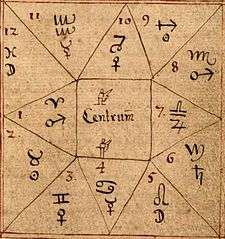
18th century Icelandic manuscript showing astrological houses and glyphs for planets and signs.
Central to horoscopic astrology and its branches is the calculation of the horoscope or astrological chart. This two-dimensional diagrammatic representation shows the celestial bodies' apparent positions in the heavens from the vantage of a location on Earth at a given time and place. The horoscope is also divided into twelve different celestial houses which govern different areas of life. Calculations performed in casting a horoscope involve arithmetic and simple geometry which serve to locate the apparent position of heavenly bodies on desired dates and times based on astronomical tables. In ancient Hellenistic astrology the ascendant demarcated the first celestial house of a horoscope. The word for the ascendant in Greek was ὡροσκόπος (hōroskopos) from which horoscope derives. In modern times, the word has come to refer to the astrological chart as a whole.

 Branches

Traditions of horoscopic astrology can be divided into four branches that are each directed towards specific subjects or purposes. Often these branches use a unique set of techniques, or a different application of the core principles of the system to a different area. Many other subsets and applications of astrology are derived from these four fundamental branches.
Natal astrology is the study of a person's natal chart to gain information about the individual and their life experience. Katarchic astrology includes both electional and event astrology. The former uses astrology to determine the most auspicious moment to begin an enterprise or undertaking, and the latter to understand everything about an event from the time at which it took place. Horary astrology is used to answer a specific question by studying the chart of the moment the question is posed to an astrologer. Mundane or world astrology is the application of astrology to world events, including weather, earthquakes, and the rise and fall of empires or religions. This includes the Astrological Ages, such as the Age of Aquarius, Age of Pisces, and so on. Each age is about 2,150 years in length, and many people use these massive ages to characterize and describe major historical ages, as well as current developments in the world.

 History

15th century image from the Très Riches Heures du Duc de Berry showing projected correlations between areas of the body and the zodiacal signs.
Many believe that the origins of much of the astrological doctrine and method that would later develop in Asia, Europe, and the Middle East are found among the ancient Babylonians and their system of celestial omens that began to be compiled around the middle of the 2nd millennium BC. They believe this system of celestial omens later spread, either directly or indirectly through the Babylonians and Assyrians, to other areas such as the Middle East, and Greece, where it merged with pre-existing indigenous forms of astrology. Thus, Babylonian astrology migrated to Greece, initially as early as the middle of the 4th century BC, and then around the late 2nd or early 1st century BC, after the Alexandrian conquests, this Babylonian astrology was mixed with the Egyptian tradition of decanic astrology to create horoscopic astrology. This new form of astrology, which appears to have originated in Alexandrian Egypt, spread across the ancient world into Europe, the Middle East, and India with varying degrees of influence.

 Before the modern era

Hand-colored version of the anonymous Flammarion woodcut (1888).
The differentiation between astronomy and astrology varied from place to place; they were strongly linked in ancient India, ancient Babylonia and medieval Europe, but separated to an extent in the Hellenistic world. The first semantic distinction between astrology and astronomy was probably given by Isidore of Seville (see astrology and astronomy).
The pattern of astronomical knowledge gained from astrological endeavors has been historically repeated across numerous cultures, from ancient India through the classical Maya civilization to medieval Europe. Given this historical contribution, astrology has been called a protoscience along with disciplines such as alchemy.
Astrology was not without criticism before the modern era; it was often challenged by Hellenistic skeptics, church authorities, and medieval Muslim astronomers, such as Al-Farabi (Alpharabius), Ibn al-Haytham (Alhazen), Abū Rayhān al-Bīrūnī, Avicenna and Averroes. Their reasons for refuting astrology were often due to both scientific (the methods used by astrologers being conjectural rather than empirical) and religious (conflicts with orthodox Islamic scholars) reasons. Ibn Qayyim Al-Jawziyya (1292–1350), in his Miftah Dar al-SaCadah, used empirical arguments in astronomy in order to refute astrology and divination.
Many prominent thinkers, philosophers and scientists, such as Galen, Paracelsus, Girolamo Cardan, Nicolaus Copernicus, Taqi al-Din, Tycho Brahe, Galileo Galilei, Johannes Kepler, Carl Jung and others, practiced or significantly contributed to astrology.

 Contemporary changes

Several innovations have occurred in contemporary astrological practice.

 Western

During the middle of the 20th century, Alfred Witte and, following him, Reinhold Ebertin pioneered the use of midpoints (see Midpoint (astrology)) in horoscopic analysis. From the 1930s to the 1980s, astrologers including Dane Rudhyar, Liz Greene and Stephen Arroyo pioneered the use of astrology for psychological analysis, with some following the lead of psychologists like Carl Jung. In the 1930s, Don Neroman developed and popularized in Europe a form of Locational Astrology under the name of "Astrogeography". In the 1970s, American astrologer Jim Lewis developed and popularized a different approach under the name of Astrocartography. Both methods purport to identify varying life conditions through differences in location.

 Vedic (Hindu astrology)

Indian astrology uses a different zodiac than Western astrology and is a branch of Vedic science. In India, there is a long-established widespread belief in astrology, and it is commonly used for daily life, foremost with regard to marriages, and secondarily with regard to career and electional and karmic astrology. In the 1960s, H.R. Seshadri Iyer, introduced a system including the concepts of yogi and avayogi. It generated interest with research oriented astrologers in the West. From the early 1990s, Indian vedic astrologer and author, V.K. Choudhry has created and developed the Systems' Approach for Interpreting Horoscopes, a simplified system of Jyotish (predictive astrology) The system, also known as "SA", helps those who are trying to learn Jyotisha. The late K.S. Krishnamurti developed the Krishnamurti Paddhati system based on the analysis of the stars (nakshatras), by sub-dividing the stars in the ratio of the dasha of the concerned planets. The system is also known as "KP" and "sub theory". In 2001, Indian scientists and politicians debated and critiqued a proposal to use state money to fund research into Vedic astrology.

Effects on world culture

Belief in astrology holds firm today in many parts of the world: in one poll, 31% of Americans expressed a belief in astrology and, according to another study, 39% considered it scientific.
Astrology has had an influence on both language and literature. For example, influenza, from medieval Latin influentia meaning influence, was so named because doctors once believed epidemics to be caused by unfavorable planetary and stellar influences. The word "disaster" comes from the Italian disastro, derived from the negative prefix dis- and from Latin aster "star", thus meaning "ill-starred". Adjectives "lunatic" (Luna/Moon), "mercurial" (Mercury), "venereal" (Venus), "martial" (Mars), "jovial" (Jupiter/Jove), and "saturnine" (Saturn) are all old words used to describe personal qualities said to resemble or be highly influenced by the astrological characteristics of the planet, some of which are derived from the attributes of the ancient Roman gods they are named after. In literature, many writers, notably Geoffrey Chaucer and William Shakespeare, used astrological symbolism to add subtlety and nuance to the description of their characters' motivation(s). More recently, Michael Ward has proposed that C.S. Lewis imbued his Chronicles of Narnia with the characteristics and symbols of the seven heavens. Often, an understanding of astrological symbolism is needed to fully appreciate such literature.

Astrology and science

Pseudoscientific concepts

Claims
Measurable correlations can be reliably found between the position of the planets and personality and human events.
Related scientific disciplines
Astronomy, Psychology
Year proposed
antiquity
Original proponents
ancient priests and astrologers
Subsequent proponents
Philip Berg, Michel Gauquelin, Linda Goodman, Liz Greene, Alan Leo, Sydney Omarr, Joan Quigley, Jackie Stallone, Athena Starwoman, Shelley von Strunckel, Richard Tarnas
In the Islamic world astrology was rejected during the turn of the 2nd millennium AD owing to the development of the scientific method and the work of al-Farabi, Alhacen, al-Biruni, Avicenna and Averroes, who made a semantic distinction between astronomy and astrology and helped to render astrology obsolete for Muslims. Muslim views on astrology have generally remained negative.
By the time of Francis Bacon and the scientific revolution, newly emerging scientific disciplines acquired a method of systematic empirical induction based upon experimental observations. At this point, astrology and astronomy began to diverge; astronomy became regarded as one of the empirical sciences, while astrology came to be understood as a part of scholastic metaphysics, and was increasingly viewed as an occult science or superstition by natural scientists. For example, Christiaan Huygens wrote in his Cosmotheoros: "And as for the Judicial Astrology, that pretends to foretel what is to come, it is such a ridiculous, and oftentimes mischievous Folly, that I do not think it fit to be so much as named." This separation accelerated through the 18th and 19th centuries.
Contemporary scientists, such as Richard Dawkins and Stephen Hawking, regard astrology as unscientific, and those such as Andrew Fraknoi of the Astronomical Society of the Pacific have labeled it a pseudoscience. In 1975, the American Humanist Association characterized those who have faith in astrology as doing so "in spite of the fact that there is no verified scientific basis for their beliefs, and indeed that there is strong evidence to the contrary".Astronomer Carl Sagan was unwilling to sign the statement, not because he felt astrology was valid, but because he found the statement's tone authoritarian. Sagan stated that he would instead have been willing to sign a statement describing and refuting the principal tenets of astrological belief, which he believed would have been more persuasive and would have produced less controversy than the circulated statement.
Astrophysicist Neil deGrasse Tyson asserted that "astrology was discredited 600 years ago with the birth of modern science. 'To teach it as though you are contributing to the fundamental knowledge of an informed electorate is astonishing in this, the 21st century'. Education should be about knowing how to think, 'And part of knowing how to think is knowing how the laws of nature shape the world around us. Without that knowledge, without that capacity to think, you can easily become a victim of people who seek to take advantage of you'".
Although astrology has not been considered a science for some time, it has been the subject of considerable research by astrologers since the beginning of the 20th century. In their study of 20th-century research into natal astrology, Geoffrey Dean, a former astrologer who became critical of the field, and coauthors documented this burgeoning research activity performed primarily within the astrological community.[57]

Research

The Mars effect: relative frequency of the diurnal position of Mars in the birth chart of "eminent athletes"[clarification needed] (after Michel Gauquelin 1991
Studies have repeatedly failed to demonstrate statistically significant relationships between astrological predictions and operationally defined outcomes. Effect size tests of astrology-based hypotheses conclude that the mean accuracy of astrological predictions is no greater than what is expected by chance. For example, when testing for cognitive, behavioral, physical and other variables, one study of 2000 astrological "time twins" born within minutes of each other did not show a celestial influence on human characteristics. It has been suggested that other statistical research is often wrongly seen as evidence for astrology due to uncontrolled artifacts.
Experimental psychologists have suggested that several different psychological phenomena can contribute to perception of astrological accuracy. One, related to confirmation bias, is that people who are given a set of multiple predictions tend to remember more of the accurate predictions ("hits") than the inaccurate ones ("misses"). Consequently, people tend to recall the set of predictions as being more accurate than it actually was. When astrological predictions turn out to correspond with some phenomena but not with others, the recollected integrity of these predictions may stem in part from this phenomenon. A second, called the Forer effect, is that individuals tend to give high accuracy ratings to descriptions of their personality that are presented to them as tailored specifically for them, but which are in fact vague and general enough to apply to a wide range of people. When predictions use vague language, the appearance that they are specific to the individual may be partially attributable to the Forer effect.
The French psychologist and statistician who devoted his life to the attempt to demonstrate the validity of certain fundamentals of astrology, Michel Gauquelin, wrote that he had found correlations between some planetary positions and certain human traits such as vocations. Gauquelin's most widely known concept is the Mars effect, which denotes a correlation between the planet Mars occupying certain positions in the sky more often at the birth of eminent sports champions than at the birth of ordinary people. A similar idea is explored by Richard Tarnas in his work Cosmos and Psyche, in which he examines correspondences between planetary alignments and historically significant events and individuals. Since its original publication in 1955, the Mars effect has been the subject of critical studies and skeptical publications which aim to refute it, and of studies in fringe journals used to support or expand the original ideas. Gauquelin's research has not received mainstream scientific notice.

Obstacles to research

The Ptolemaic system depicted by Andreas Cellarius, 1660/61
Astrologers have argued that there are significant obstacles in carrying out scientific research into astrology today, including lack of funding, lack of background in science and statistics by astrologers, and insufficient expertise in astrology by research scientists and skeptics. Some astrologers have argued that few practitioners today pursue scientific testing of astrology because they feel that working with clients on a daily basis provides personal validation for their clients.
Another argument made by astrologers is that most studies of astrology do not reflect the nature of astrological practice and that the scientific method does not apply to astrology. Some astrology proponents argue that the prevailing attitudes and motives of many opponents of astrology introduce conscious or unconscious bias in the formulation of hypotheses to be tested, the conduct of the tests, and the reporting of results.

Mechanism

Early geometry was connected to the divine for most medieval scholars. The compass in this 13th century manuscript is a symbol of God's act of creation via the divine or perfect circle.
Astrologers have not presented consistent explanations of physical mechanisms underlying astrological beliefs, and few modern astrologers believe in a direct causal relationship between heavenly bodies and earthly events. An editorial published by the Astronomical Society of the Pacific reports no evidence for a scientifically defined mechanism by which celestial objects can influence terrestrial affairs. Researchers have posited acausal, purely correlative, relationships between astrological observations and events, such as the theory of synchronicity proposed by Carl Jung. Others have posited a basis in divination. Others have argued that empirical correlations stand on their own epistemologically, and do not need the support of any theory or mechanism. To some observers, and most astrologers, these non-mechanistic concepts raise serious questions about the feasibility of validating astrology through scientific testing, and some have gone so far as to reject the applicability of the scientific method to astrology entirely. Some astrologers, a minority, on the other hand, believe that astrology is amenable to the scientific method, given sufficiently sophisticated analytical methods, and they cite pilot studies to support this view. Consequently, several astrologers have called for or advocated continuing studies of astrology based on statistical validation.